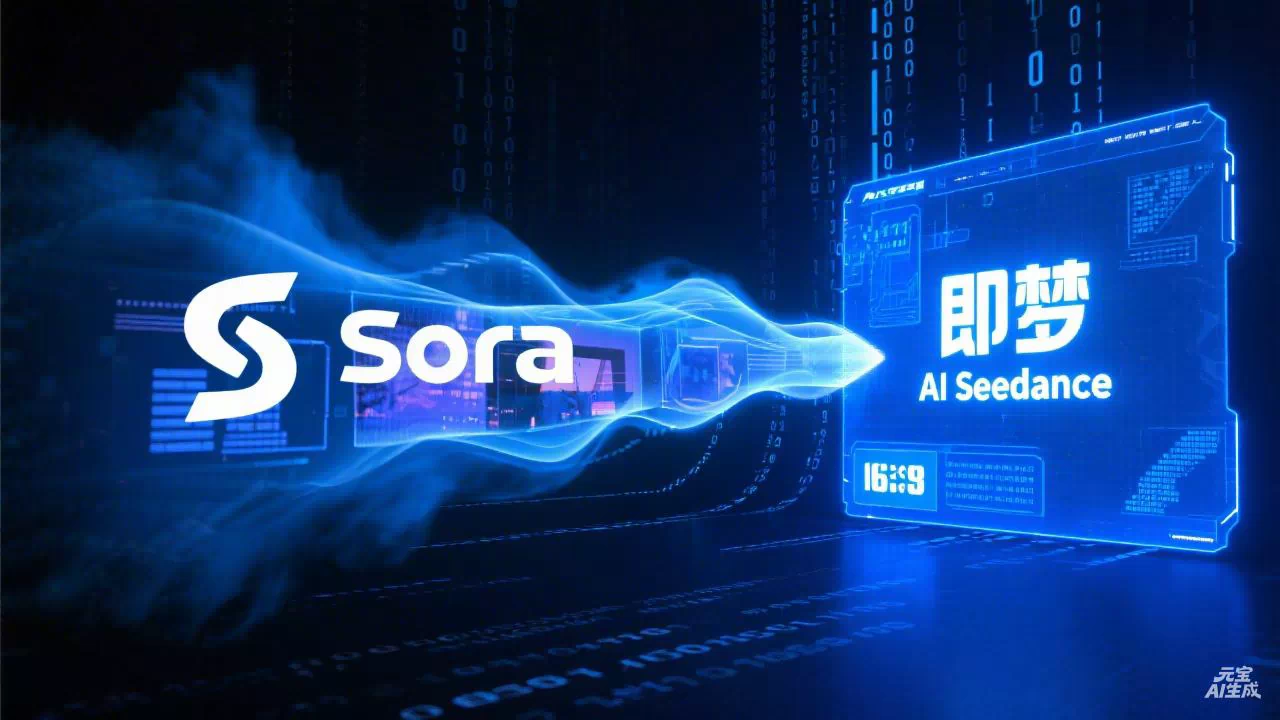
1. Sora's "Flash of Brilliance": From Technical Awe to Commercial Predicament
A Sudden Farewell On March 25, 2026, OpenAI announced via Sora’s official social accounts the complete shutdown of its AI video generation project, including the standalone consumer app, developer API, and ChatGPT-integrated video generation features, and simultaneously terminated all technical iterations and operational maintenance for the project. The decision left no room for cushioning—the company made clear it would "officially bid farewell to Sora," and expressed gratitude to all users and creators who participated in creating and sharing with Sora.
Three Core Reasons for the Shutdown OpenAI CEO Sam Altman revealed the main reasons for the shutdown in an internal staff meeting:
-
Severe strain on compute and R&D resources: During operation, Sora’s compute consumption far exceeded expectations, with monthly compute costs surpassing tens of millions of dollars, and commercial revenue unable to cover the high operational and R&D expenses.
-
Company-wide strategic retrenchment: OpenAI will concentrate all personnel, compute, and financial resources on developing next-generation AGI models and AI systems that interact with the physical world, and will completely exit the standalone AI video generation track.
-
Escalating compliance and content-risk pressure: Sora’s hyper-realistic generated videos easily triggered issues like misinformation and copyright infringement. Regulatory scrutiny tightened across many regions, making the cost and risk of subsequent remediation uncontrollable.
Commercial Difficulties Although Sora had strong attention-grabbing capability, it never established a clear commercialization path and faced slowing user growth and monetization challenges. According to Appfigures’ mobile platform estimates, Sora’s in-app total revenue since launch was only about $2.1 million. This figure contrasts sharply with OpenAI’s high investment, highlighting the real challenges of commercializing AI-generated video.
2. Ji Meng AI Seedance 2.0: Localization Advantages and Technical Breakthroughs
ByteDance’s AI Video Ambition As Sora exits, ByteDance’s Ji Meng AI Seedance 2.0 is rapidly rising to become a leading domestic player in the AI video generation field. Along with Keling 3.0 (Kuaishou), MiniMax’s Hailuo 2.3, and Shengshu Technology’s Vidu Q3, it forms the current core competitive landscape of domestic AI video generation models.
Core Technical Advantages Ji Meng AI Seedance 2.0 demonstrates competitive advantages across multiple dimensions:
-
Broad multimodal input: Supports 12 file types, including images, videos, and text, offering users more flexible creation options.
-
Obvious cost advantage: In pricing, generating a 5-second 720p video costs about RMB 2.3 with Seedance, versus about RMB 4 with Keling—just a bit more than half the price of Keling. For 15-second videos, Seedance’s pricing advantage is even more pronounced.
-
Strong localization features: Seedance shows strong localized advantages in precise text embedding, special effects, and the aesthetic handling of Chinese characters. With the same prompts, Sora’s text-effect videos are far inferior to Seedance’s.
Breakthrough in Audio-Visual Synchronization Seedance 2.0 has achieved a generational leap in audio-visual synchronization and supports multi-language audio generation; this feature entered its roadmap for Q2 2026. In contrast, MiniMax’s Hailuo 2.3 generates fairly realistic video but cannot produce audio and visuals simultaneously, requiring post-production dubbing.
3. Sora vs Seedance: Comparison of Technical Paths and Market Positioning
Differences in Technical Capabilities Comparing technical parameters, Seedance 2.0 and Sora show clear differences:
- Resolution support: Seedance supports up to 1080p, while Sora can generate cinematic-quality video.
- Motion control: Seedance’s motion control is limited (only 3-axis), whereas Sora performs better in simulating the physical world.
- Generated duration: Seedance can stably output 15-second videos, while Sora may still hold advantages in long-shot narrative logic and artistic aesthetics.
Differences in Market Positioning Seedance 2.0’s strategy focuses on "deliverability." Compared to Sora: Sora may still have advantages in long-shot narrative logic and artistic aesthetics, but its public beta progressed slowly. Seedance 2.0 is "ready out of the box," solving practical usability issues through first-and-last-frame control and consistency algorithms.
User Experience Comparison User tests indicate Seedance 2.0 achieves better overall visual final-product quality. In scenes with big, dramatic actions like character videos and special-effect transitions, Sora still performs well and provides a strong sense of physical-world simulation. However, in the niche area of "text special effects," Sora is almost completely uncompetitive with Seedance.
4. The New Landscape of the AI Video Generation Market
First-Tier Competitive Landscape After Sora’s exit, the AI video generation market has consolidated around four main players plus a group of followers. The current first tier includes:
- Keling 3.0 (Kuaishou): strong in motion control and 4K resolution
- Seedance 2.0 (ByteDance): leading in multimodal input breadth and cost-effectiveness
- Veo 3.1 (Google): outstanding in physical simulation
- Runway Gen-4.5: ranked highest in visual fidelity
Enterprise Client Distribution By number of enterprise clients, Keling has 30,000+ enterprise customers, Seedance has 12,000+, Runway has 18,000+, and Veo is estimated to have 8,000+. These figures reflect each platform’s penetration in the enterprise market.
Cost-Effectiveness Analysis In per-second cost (API), Seedance 2.0 has a clear advantage at $0.022, far lower than Keling’s $0.084, Veo’s $0.12, and Runway’s $0.14. This price advantage makes Seedance more attractive to ordinary creators and SMEs.
5. Future Outlook: Challenges and Opportunities for AI Video Generation
Directions for Technical Evolution AI video generation technology is advancing in the following directions:
- Longer durations and higher consistency: generating videos from several seconds to several minutes while maintaining consistency of characters and scenes
- Finer motion control: achieving more complex camera language and action design
- Stronger understanding of the physical world: improving simulation of lighting, materials, and physical laws
- Smarter storytelling capabilities: advanced features like automatic storyboarding and coherent plot progression
Exploring Commercialization Paths Sora’s exit serves as a wake-up call to the whole industry. Multimodal large model R&D remains important, but integrating text generation, code writing, and task execution capabilities into customers’ real business workflows to produce quantifiable ROI will increasingly become a key consideration for AI companies.
Regulatory and Ethical Challenges As AI-generated videos become increasingly realistic, regulatory and ethical issues are becoming more prominent. Problems like misinformation, copyright infringement, and privacy protection require industry-wide attention and solutions. Domestic platforms like Seedance may have innate advantages in localized compliance, but they still need to continuously invest resources to build robust content review and risk-control systems.
Ecosystem Building and Developer Support Building a healthy developer ecosystem is crucial for the long-term development of AI video platforms. Seedance needs to provide more comprehensive API documentation, more stable services, and a richer toolchain to attract more developers and creators to its ecosystem and create a virtuous cycle.
Conclusion
Sora’s quiet exit is not the end of AI video generation technology, but an important turning point for the industry from technical showmanship to business pragmatism. Ji Meng AI Seedance 2.0, with its localization advantages, cost-effectiveness, and practical orientation, is demonstrating strong market competitiveness. However, the AI video generation track still faces multiple challenges in technical breakthroughs, commercialization exploration, and regulatory compliance.
For creators, Sora’s exit means reevaluating and choosing AI video tools; for the industry, it marks a shift in competition from pure technological leadership to comprehensive capability competition. Whether Seedance can seize this historic opportunity will depend not only on its technical strength but also on its ecosystem building, user experience, and commercial innovation.
In today’s era of rapid AI iteration, there are no permanent leaders, only continuous innovators. Sora’s story reminds us that even the most dazzling technology needs a sustainable commercialization path. The rise of Ji Meng AI Seedance 2.0 showcases the value of localized innovation and pragmatism. In the future, the AI video generation market will become more diversified and professionalized, and the ultimate beneficiaries will be creators and users.