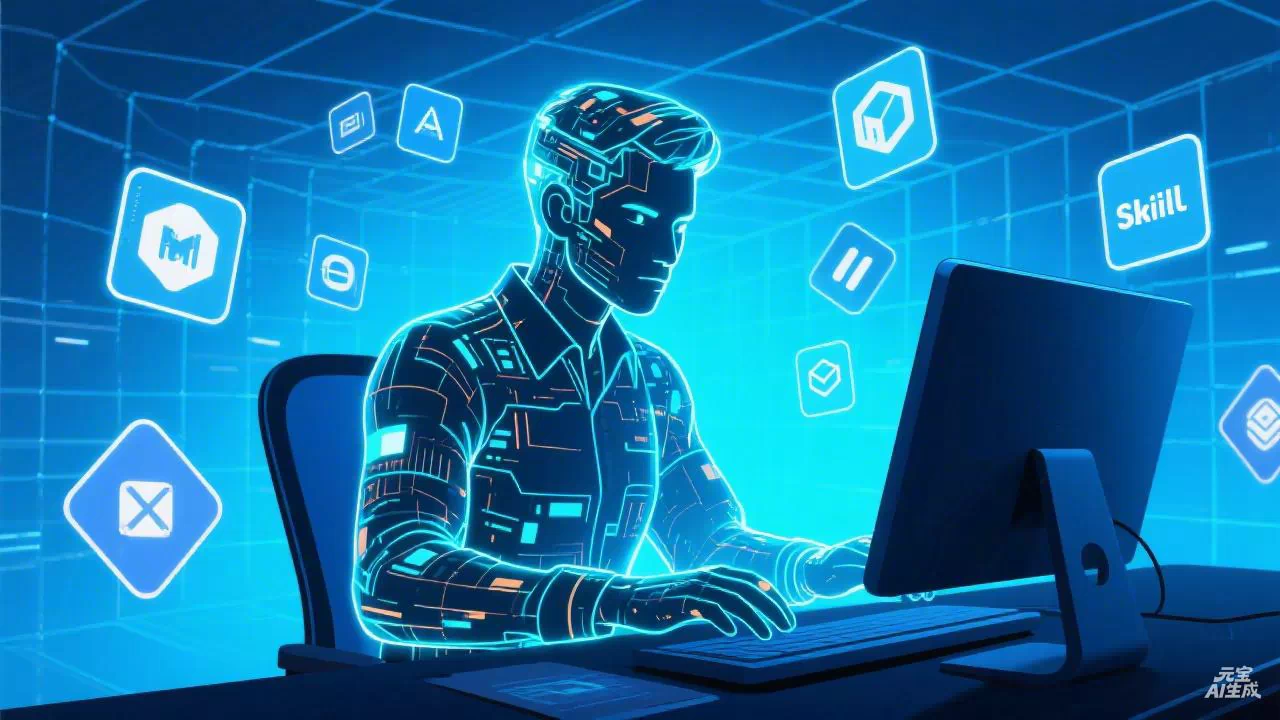

What is Colleague.Skill?
Colleague.Skill (colleague-skill) is an open-source project following the AgentSkills standard. Its core goal is to "refine" the documents, messages, code, experience, and even communication habits left behind by colleagues after they leave, transfer, or hand over their work, into an AI Skill that can continue to "work on the job".
Unlike simple chatbots or knowledge bases, Colleague.Skill adopts a dual-layer architecture design:
- Work Skill Layer: Replicates hard-core work assets, including the systems they managed, technical specifications, work processes, project experience, pitfall records, and all other actionable professional capabilities.
- Persona Layer: Recreates soft skills and work style through a five-layer personality structure, completely replicating the person's identity positioning, expression style, decision-making patterns, interpersonal behavior, and even the unwritten rules and boundaries of workplace communication.
Technical Implementation and Operation Process
From a technical perspective, Colleague.Skill is essentially a "crawler plus prompt template" project. Each "digital colleague" is a subdirectory containing several Markdown files: Skill.md is the main entry point, work.md describes the work, persona.md describes the personality, plus a meta.json for metadata.
Comprehensive data source coverage:
- Automated collection: Supports API interfaces for mainstream workplace software like Feishu, DingTalk, and Slack
- Manual upload: PDF documents, images/screenshots, email .eml/.mbox formats, Markdown files
- Chat history: Adapted for formats from open-source export tools like WeChatMsg and PyWxDump
Simple and intuitive generation workflow:
- Enter the
/create-colleaguecommand in Claude Code - Fill in colleague name, job level, personality tags, and other information as prompted
- Provide data sources (automatic collection or manual upload)
- System automatically analyzes and generates work.md and persona.md files
Core Application Scenarios
1. Offboarding handover, preventing knowledge loss This is the most core use case for Colleague.Skill. After many key colleagues leave, they only leave a few pages of handover documents, which cannot cover their 3-5 years of tacit experience (such as project pitfalls, collaboration tips, decision-making logic), leaving newcomers at a loss.
2. Standardized onboarding for new hires Encapsulate the team's workflows, standards, and FAQs entirely. New hires don't need to repeatedly disturb senior colleagues—just invoke the Skill to get standardized, highly accurate answers.
3. Cross-functional collaboration efficiency 80% of workplace friction comes from misaligned communication. Colleague.Skill helps you precisely match your contact's communication rhythm, significantly reducing cross-department and cross-role communication costs.
4. Business decision prediction Solidify product experts' requirement review logic and marketing leads' advertising judgment criteria into Skills. When making plans or setting strategies, use AI for a round of prediction in advance, greatly reducing trial-and-error costs.
Controversies and Legal Risks Triggered
The popularity of Colleague.Skill has also sparked widespread social discussion and legal concerns:
Prominent legal risks:
- Collecting and using employee-related data for AI training without their consent directly violates their rights to collection, use, and processing of personal information, with penalties up to 7 years
- Once work experience, collaboration methods, and even stylistic characteristics are modularized, the question of how to protect the labor value, intellectual property, and personal dignity concentrated within them becomes a difficult problem
Technical limitations:
- What can be "distilled" is mainly the part that appears repeatedly in behavior, can leave records, and has some stability
- AI can "learn" language style and work processes from external traces like chat records, but cannot "learn" the more core yet intangible intuition, judgment, and sense of responsibility
- The output is a "persona-like skill package" without subjective initiative or creativity, not a true "digital twin"
Workplace ethics challenges:
- The project slogan "Turning cold departures into warm Skills" has been criticized as dark humor
- Social media is flooded with memes: "Your colleague was optimized, but their skill remains" "The graduated colleague hasn't disappeared—they've just been distilled into tokens to continue accompanying you"
- Sparking deep reflection on "Is AI eating workplace experience"
Ecosystem Expansion of the Skill Universe
The success of Colleague.Skill has given birth to a complete "Skill Universe" ecosystem:
- Boss.Skill: Learns management decision logic, speaking style, and evaluation criteria—can be used for report simulations and work predictions
- Ex.Skill: Import pre-breakup WeChat chat logs to generate an AI ex-partner
- Anti-Distillation.Skill: Performs fuzzy processing on personal core experience to protect knowledge assets and prevent direct copying and extraction
Future Outlook and Reflections
The Colleague.Skill phenomenon reflects the profound impact of AI technology on workplace ecosystems:
Positive significance:
- Solved the workplace pain point of "departure equals knowledge gap"
- Provided new thinking for knowledge accumulation and experience inheritance
- Reduced costs for new employee training and cross-team collaboration
Need for vigilance:
- The impact of AI on labor requires greater attention, and relevant legal gaps urgently need to be filled
- Need to focus on the impact of AI substitution effects on the talent pipeline
- How to guide employers to balance individual interests with collective interests has become an urgent issue
Chen Tianhao, a tenured associate professor at the School of Public Policy and Management at Tsinghua University, pointed out: "If people's work experience, collaboration methods, and even stylistic characteristics can all be modularized, then how should the labor value, intellectual property, and personal dignity concentrated within them be protected?"
Conclusion
The popularity of Colleague.Skill is not accidental—it precisely hits the workplace pain point of "people leave, connections cool, experience gaps". Although the technical implementation is relatively simple, the discussions it has triggered about digital immortality, labor value, intellectual property, and workplace ethics are extraordinarily profound.
In today's rapid development of AI technology, we need both to embrace the efficiency improvements technology brings and remain vigilant about the possible risks of alienation that technology might bring. Colleague.Skill may just be the beginning of AI reshaping workplace relationships. On this road to cybernetic immortality, how to retain the warmth of humanity while发挥技术的价值, will be a topic all workplace professionals need to think about together.
As the project introduction states: "Turn cold departures into warm Skills. This is the correct way to open cybernetic immortality." But where are the boundaries of this road, and how to draw the line between warmth and coldness, requires us to continue exploring and defining in practice.