




LatticeDB
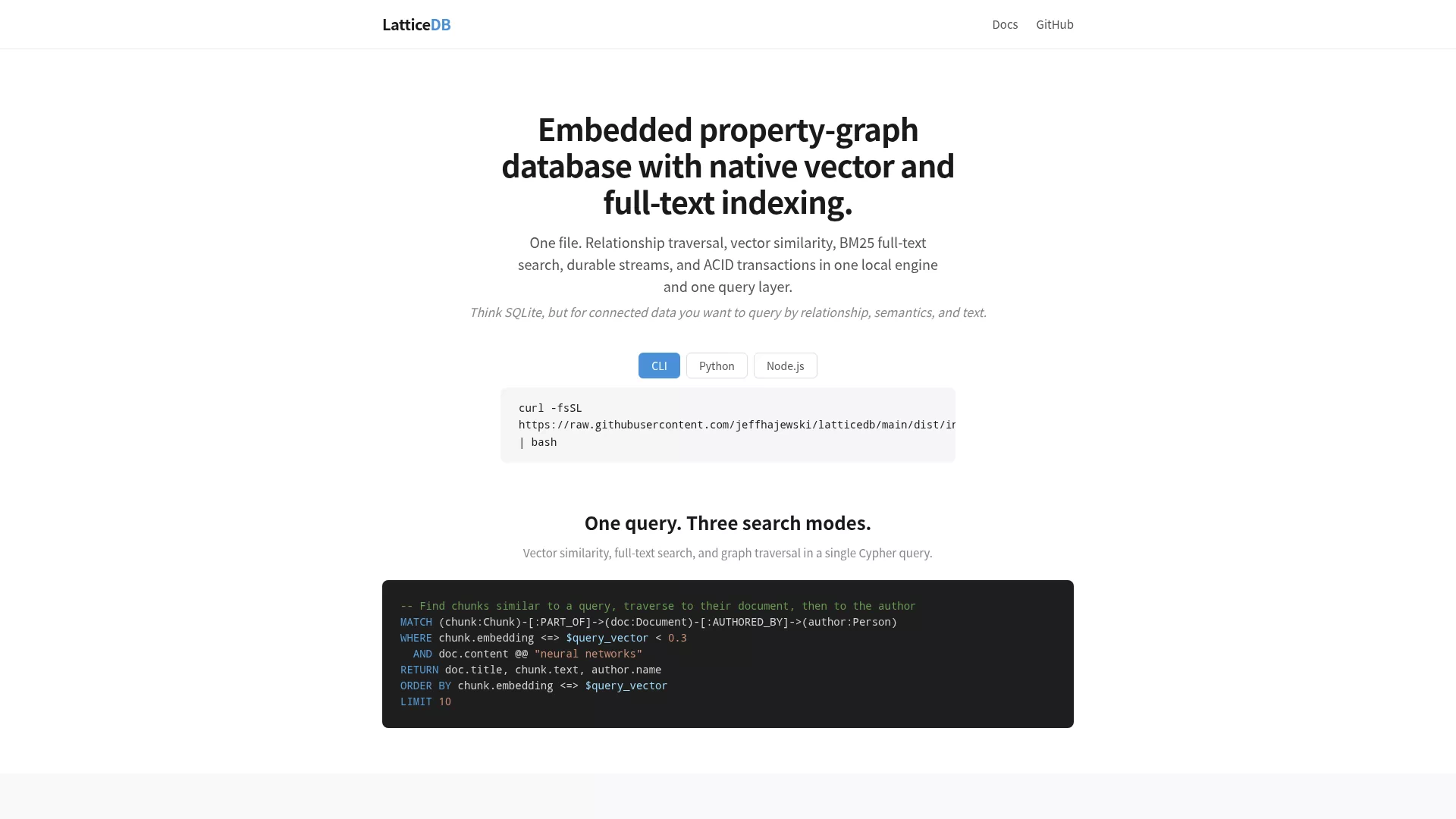
LatticeDB is an embedded graph database written in Zig, deployed as a single file with zero configuration. Its key selling point is combining graph traversal, HNSW vector similarity search, and BM25 full-text search in a single query layer. Anyone who has built Graph RAG projects knows the pain: Neo4j is heavy, vector stores and graph stores need separate maintenance, and query languages don't unify. LatticeDB compresses all of this into one file, letting you query relationships, semantics, and text with Cypher syntax.
Performance-wise, node lookups take 0.13 microseconds, and vector search over 1 million vectors completes in 0.83 milliseconds with 100% recall. These numbers come from the official README — actual performance depends on the use case. It offers Python, TypeScript, and Go bindings, plus a CLI. It suits local graph database needs for RAG applications and agent memory systems.
The 114-point HN discussion reveals the author built this because working with graph databases locally was too painful. 233 GitHub stars suggest solid community approval.
Project: github.com/jeffhajewski/latticedb | Website: latticedb.org
TeXbrain
TeXbrain is a LaTeX editor that runs entirely in your browser, with the pdfTeX engine compiled to WebAssembly. Open a browser tab, write LaTeX, and get live PDF compilation without installing anything.
It addresses two long-standing pain points: online LaTeX platforms lock Git sync behind paywalls, and local LaTeX environments break when migrating between machines. TeXbrain's approach runs the compiler, editor, and Git client entirely client-side — pdfTeX via SwiftLaTeX compiled to WASM, Git through isomorphic-git's pure JS implementation, and PDF rendering via pdf.js. File read/write uses the File System Access API to operate directly on your local disk.
CTAN packages are loaded on demand from mirrors and cached. Common packages ship built-in, and previously cached packages work offline. The CodeMirror 6 editor provides autocomplete for 70+ LaTeX commands. Project templates cover theses, reports, Beamer presentations, resumes, and more.
51 points on HN, 76 GitHub stars. The author wrote in the README that fighting with LaTeX tooling while writing a thesis motivated this project.
Project: github.com/swimmingbrain/texbrain | Try it: tex.swimmingbrain.dev
Maiao
Maiao brings Gerrit-style code review workflows to GitHub, GitLab, Gitea, and others. The core idea is stacked diffs: each commit automatically creates its own PR, forming a parent-child dependency chain. Reviews happen commit by commit, which is much clearer than reviewing a single PR with dozens of commits at once.
The workflow is straightforward. Make multiple commits on a branch, run git review, and Maiao creates PRs for each commit with stacking relationships. When a PR gets merged, the remaining PRs rebase automatically. It supports GitHub native Stacks, GitLab auto-detected stacking, and fixup commit management.
This tool suits teams doing large-scale code refactoring or long-cycle feature development. Previously, this workflow required paid services like Graphite. Maiao implements the same with a CLI tool, MIT licensed.
29 points on HN, 38 GitHub stars. The project is a community fork of the discontinued adevinta/maiao.
Project: github.com/runetes/maiao