



Mystra: Let AI Watch Your Payment Flows
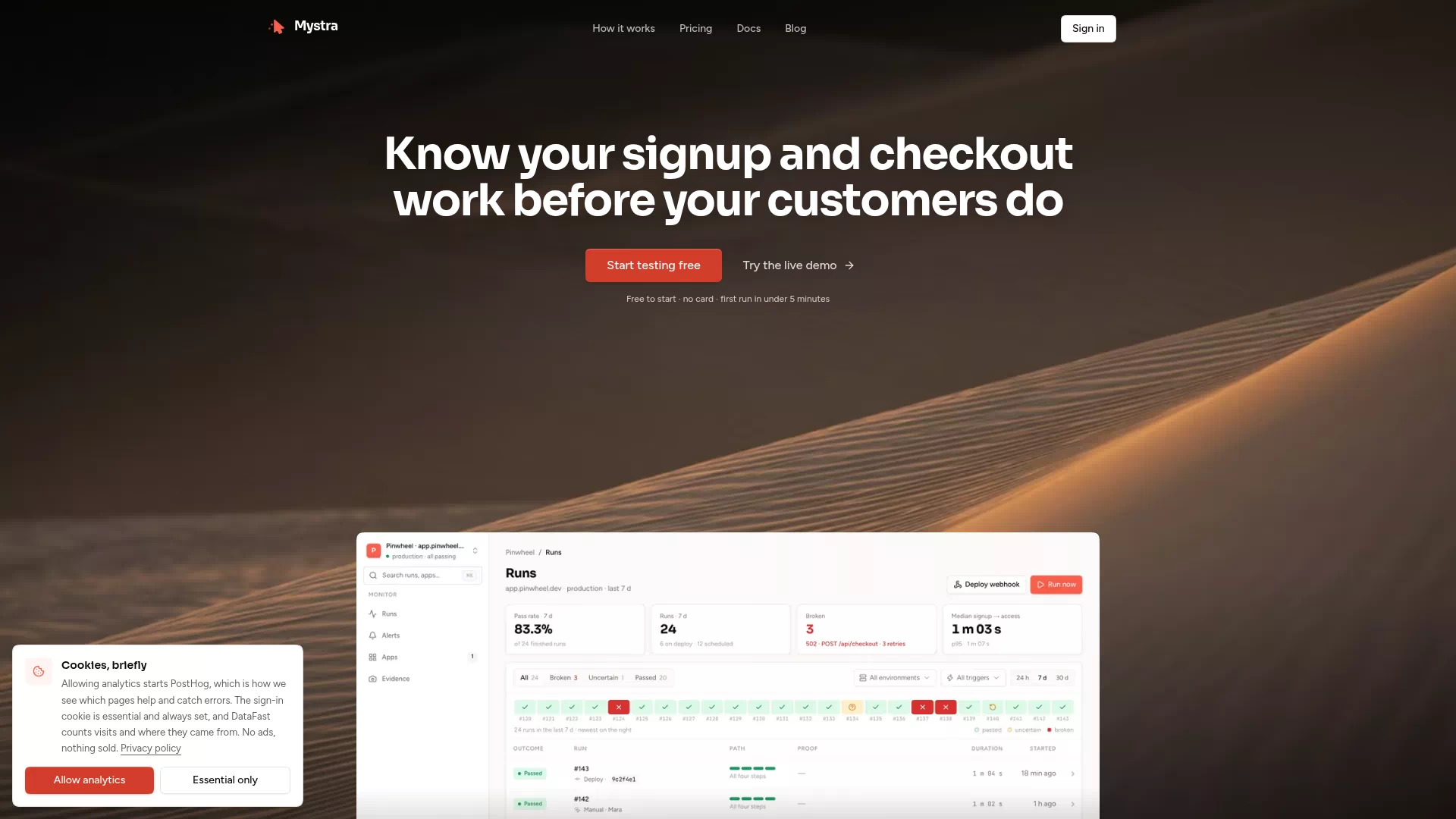
Mystra is a revenue-path monitoring tool. The idea is straightforward — every time you deploy a new version, it automatically runs through the full signup, email verification, Stripe checkout, and access unlock flow in a real browser. If anything breaks, you get screenshots, HAR files, and email trails instead of guesswork.
It supports three verification paths: Google login, Magic Link, and Stripe payment. Each test creates a fresh account, receives emails in its own inbox, actually pays a small amount, and verifies that the user gets the expected access. It does not just ping your homepage — it walks through the entire revenue chain.
Free to start with no credit card required. First run takes about five minutes. Built for SaaS products where signup and checkout are critical revenue paths — bugs in these flows are expensive, yet many teams rely on manual testing or skip testing entirely.
MDedit: Write Markdown Without Going Online
MDedit is a cross-platform Markdown editor built with Tauri + Rust, focused on two things: speed and privacy. All documents stay on your machine — nothing gets uploaded anywhere.
Feature-wise, it covers the essentials: live preview, Mermaid diagrams, KaTeX math, tabbed workspace, and light/dark themes. The editor includes syntax highlighting, automatic list continuation, global find-and-replace with regex support, and direct export to HTML, PNG, PDF, and SVG.
The desktop app tracks recent files and registers as the default handler for .md files. Split-screen mode shows source on the left and preview on the right with synchronized scrolling.
For anyone who needs to write technical documentation without relying on online editors, this tool does the job. Open source under MIT license, available on GitHub.
FetchRelay: Web Data Extraction as a Workspace
FetchRelay turns web scraping into a visual workspace. Paste a URL, and it converts the page to Markdown, structured data, or plain text — then you can inspect and refine the results directly in the interface.
It offers three scraping modes: single-page extraction, batch crawling, and sitemap generation. The built-in engine tries direct HTTP first, and automatically switches to browser rendering when it detects JavaScript-heavy pages. You can also manually choose to extract only main content, strip navigation chrome, or render at a mobile viewport width.
Beyond basic scraping, it supports page change monitoring — set a URL and get notified when the content shifts. Output formats cover Markdown, link collections, product fields, and more.
With 100 free monthly credits, FetchRelay is practical for competitive analysis, data collection, and content monitoring without maintaining your own scraping infrastructure.