1. What is OpenRouter?
In one sentence:
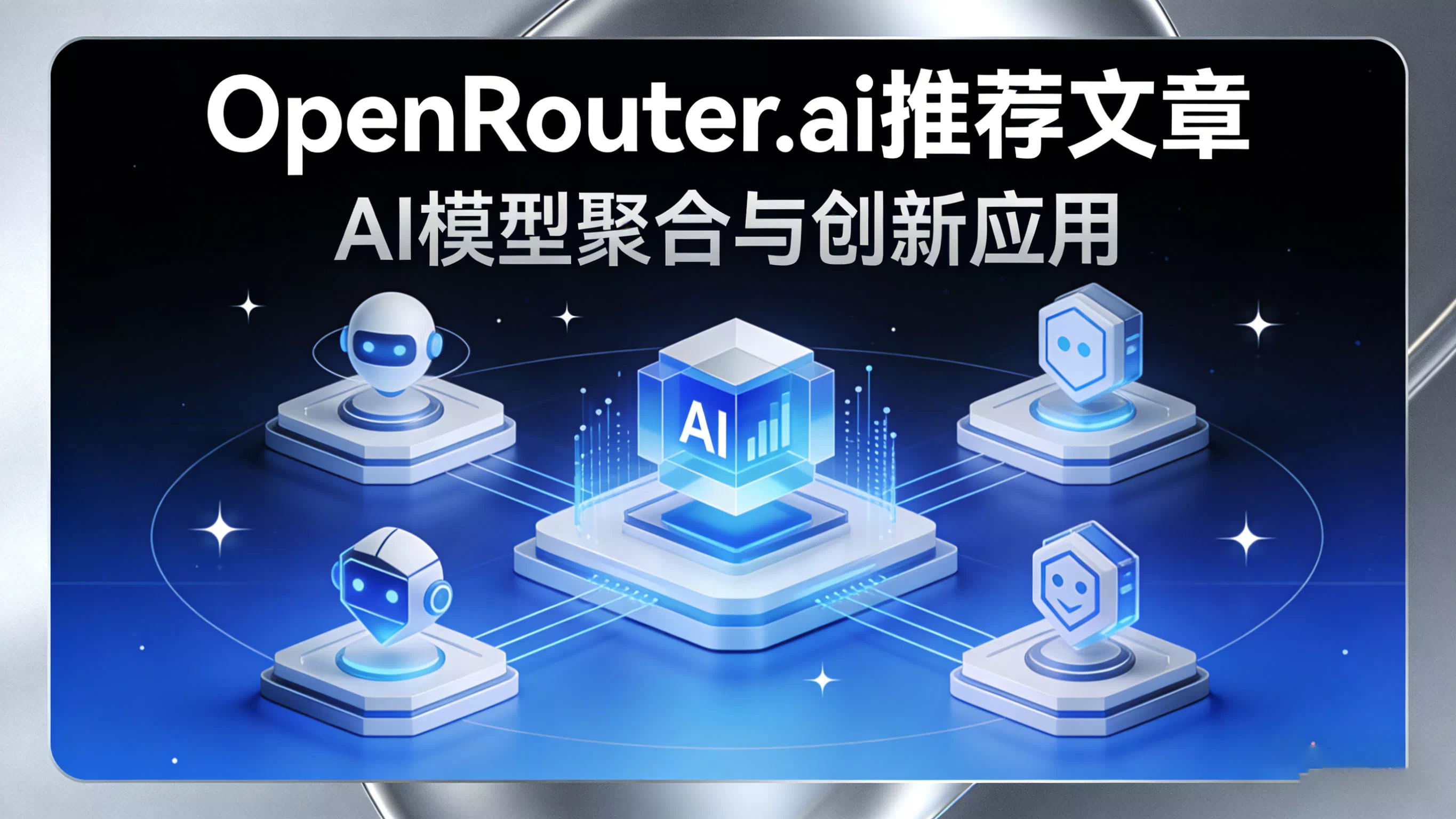
OpenRouter is a 'router' for large models — it provides a set of APIs fully compatible with OpenAI, letting you call over 200 models on the platform, including:
- Major commercial models: GPT‑4o, Claude 3.5 Sonnet, Gemini, Llama 3, etc.
- Open-source models: Mistral, Phi, Qwen, etc., no need to self-host
- Specialized models: dedicated models optimized for specific tasks (code, math, reasoning)
You no longer need to register for each model, read different documentation, or write different SDKs, nor guess which model has the best cost-performance ratio. One key, one request, switch freely.
2. Quick Start: Three Steps to Make Your First Request
OpenRouter's design principle is 'as simple as OpenAI, but more flexible.'
From zero to running your first API call usually takes no more than 5 minutes.
Step 1: Register an Account
Visit openrouter.ai and register with your email or Google account.
You can start as an individual and later create an Organization for your team, allowing multiple people to share keys and billing.
Step 2: Purchase Credits
OpenRouter uses a 'buy credits, pay-as-you-go' model, with no monthly fee and no requirement to subscribe to any particular model.
- After top-up, all models are charged based on actual token usage
- Prices for each model are clearly listed, and you can view historical usage details
- Suitable for scenarios ranging from personal projects to enterprise-scale usage
Tip: You can top up $10 or $20 initially for testing; that's enough for hundreds of conversations.
Step 3: Get an API Key and Send a Request
Generate an API Key in the Dashboard.
Then, simply use the OpenAI SDK (or any OpenAI-compatible client):
curl https://openrouter.ai/api/v1/chat/completions \
  -H "Authorization: Bearer $OPENROUTER_API_KEY" \
  -H "Content-Type: application/json" \
  -d '{
    "model": "openai/gpt-4o",
    "messages": [{"role": "user", "content": "Introduce yourself"}]
  }'
Want to switch to Claude?
Just change the "model" to "anthropic/claude-3.5-sonnet".
Want to try an open-source model? Change it to "meta-llama/llama-3-70b-instruct".
Unified model names, unified request structure, unified error handling — switching costs are almost zero.
3. Main focus of this issue: What "hidden benefits" can a single interface actually bring?
Many developers initially think OpenRouter is just a "model aggregator." In practice, its value goes far beyond that.
1. Avoid Vendor Lock-In
If you write your application directly against the OpenAI API, switching models in the future is nearly the same as rewriting.
With OpenRouter, you can switch model providers painlessly at any time, even using different models for different scenarios.
This architectural flexibility is crucial for developers building products or client projects.
2. Cost Control Down to the "Per-Task" Level
Price differences between models can be huge (sometimes up to 50x).
OpenRouter allows you to choose different models for different tasks:
- Use GPT‑4o for complex reasoning
- Use low-cost open-source models for large-scale summarization
- Use Claude for creative generation
All expenses are managed under a single account; there's no need to pre-fund multiple providers.
3. Native Support for "Multi-Model Mixing"
You can build a "model routing" logic:
- If the question requires reasoning → route to GPT‑4
- If the question involves long legal texts → route to Claude
- If the question is simple → route to a small open-source model
All of this can be implemented with a single API Key on OpenRouter.
4. A Step Change in Development Efficiency
No longer need to maintain:
- Multiple SDK versions
- Different API rate-limiting strategies
- Separate balance monitoring for each provider
- Fragmented error handling logic
Teams can shift their focus from "integrating various models" to "business logic and user experience."
4. Mini Experiment for This Issue: Comparing Three Models' Answers to the Same Question Using OpenRouter
To give you a direct feel for how OpenRouter works, here's a simple experiment (you can run it in your own environment).
The same question: "Explain quantum entanglement in one sentence."
Request three different models separately:
| Model | Sample Answer |
|---|---|
openai/gpt-4o | Once two particles become entangled, no matter how far apart they are, measuring one instantly determines the state of the other. |
anthropic/claude-3.5-sonnet | Quantum entanglement describes a mysterious connection between two particles that transcends space, where a change in one state is immediately reflected in the other. |
meta-llama/llama-3-70b-instruct | Like a pair of magic coins: when you flip one, the other responds in sync, regardless of distance. |
You can see that:
- Different models vary noticeably in style, depth, and accessibility
- On OpenRouter, you don't need to change your code structure; just change the
modelparameter - This "quick comparison" capability is extremely valuable for model selection and product tuning
5. Who Should Try OpenRouter in This First Issue?
- AI application developers: Want to quickly access multiple models and avoid being tied to a single vendor
- SaaS startup teams: Need flexible control over AI costs and may switch models in the future
- Independent developers / students: Want to try cutting-edge models at low cost without topping up multiple platforms
- Enterprise tech leads: Build a standardized AI access layer for the team with unified monitoring and billing
If you fall into any of the above categories, OpenRouter can immediately offer you a very high return on investment in this first issue.