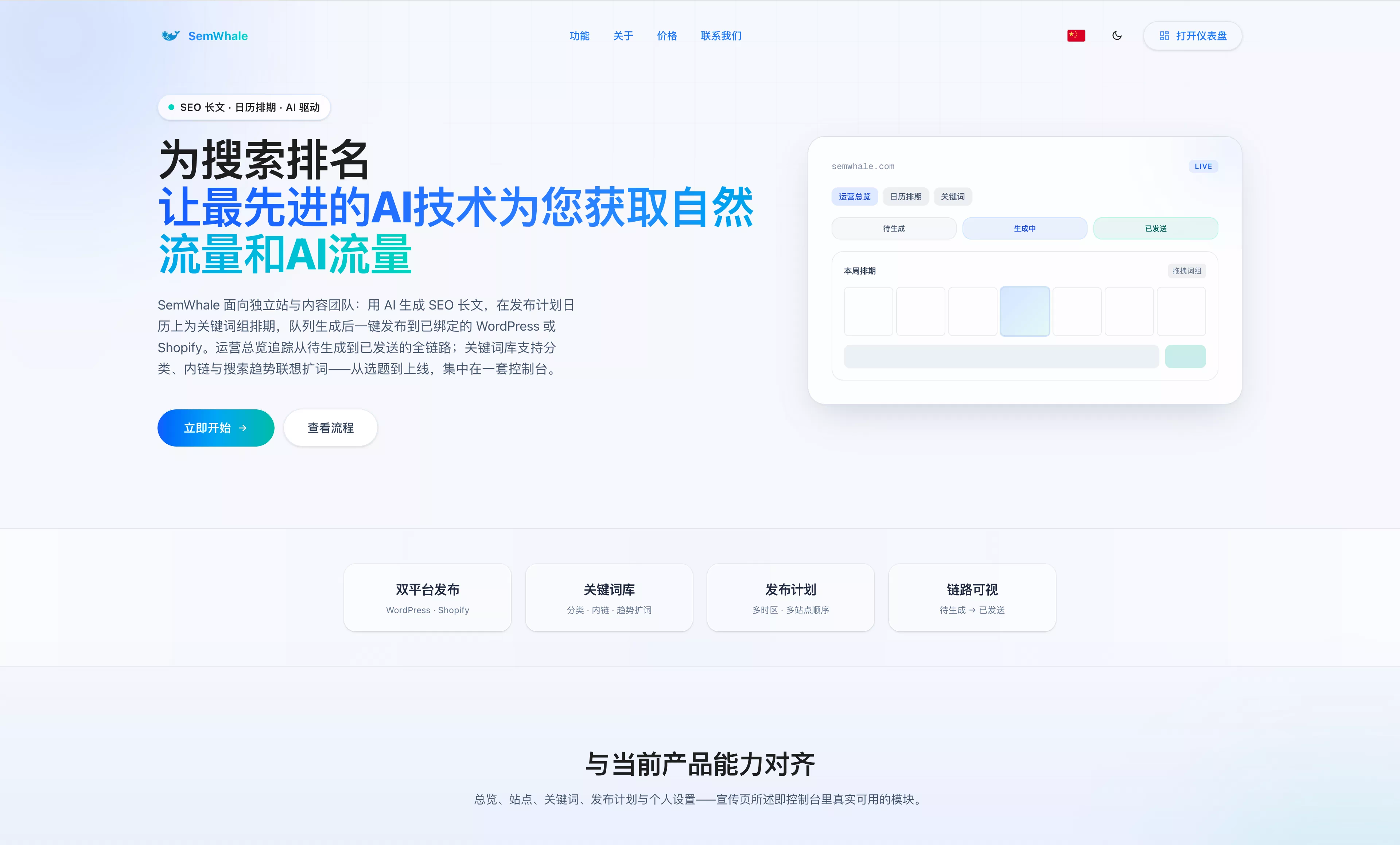
In search engine marketing (SEM), content production efficiency and distribution coverage are always core challenges for operators. Especially for standalone WordPress and Shopify sites, the continuous and stable output of long-form SEO content is key to acquiring organic traffic. SemWhale is a SaaS tool aimed at this pain point, with AI long-form generation × calendar scheduling × one-click multi-platform publishing as its core selling points, attempting to compress the entire "topic selection to go-live" process into a single console.
1. Product positioning: SEM × Whale, powerful growth like a whale
The brand name SemWhale comes from the combination of SEM (search engine marketing) and Whale, implying "whale-level growth in SEM marketing."
The official positioning is very clear: for standalone sites and content teams, helping them use AI to generate SEO long-form articles, schedule keyword groups on a publishing calendar, queue the generated content, and publish to bound WordPress or Shopify sites with one click.
2. Six core features explained
1. AI content and editing
SemWhale provides a complete long-form SEO pipeline, supporting both rich text and HTML editing modes, and allows uploading article images (as WordPress featured images / Shopify header images). Notably, it also offers an "article trial generation" feature (requires admin privileges), allowing users to debug prompts and model outputs within the same pipeline — a very useful feature for content teams focused on quality.
2. Dual publishing to WordPress and Shopify
The site binding process is straightforward: WordPress uses Application Password authentication; Shopify supports exchanging Client ID/Secret for a token, or directly pasting an Access Token. You can set intervals between platform sends when publishing, and content is delivered sequentially according to the selected site order to avoid concentrated pushes in a short time that might trigger platform risk controls.
In addition, SemWhale also supports Webhook (HTTP/HTTPS), providing extension possibilities for self-hosted sites or other CMS users.
3. Keyword library: categories + internal links + trend-based expansions
The keyword library uses a category → keyword group hierarchical structure. Each keyword group can be configured with:
- Multiple keywords (comma-separated)
- Internal links (specified keywords in the article body automatically become clickable links, up to 10)
- Google Trends trend-based keyword expansion (automatically fetches search suggestions, related queries, and rising queries based on the title)
This mechanism gives topic expansion a data basis rather than relying purely on intuition.
4. Publishing plans and calendar scheduling
Supports creating multiple publishing plans, each of which can independently set time zone and daily execution times. In the calendar view, users can drag keyword group title rows to specific dates to schedule them; the interaction is similar to dragging cards in Trello. After scheduling, click "Start Generation" to queue; once generation is complete, you can "Send to site immediately" by day.
The calendar supports month and single-day views, and the mobile app also has an "add to today's schedule" button, adapting to different usage scenarios.
5. Operations overview
The operations overview page uses a kanban-style design, intuitively presenting the full workflow status "To Generate → Generating → To Send → Sent." It also aggregates failed tasks and the last 7 days' trends, and sorts by anomaly priority to help operators fix the most urgent issues first, rather than getting lost in a sea of numbers.
6. Search trends
Built-in search trends feature aggregates Google Trends hot queries across eight industries such as tech, finance, sports, and entertainment, and updates automatically every day. Users can also enter custom keywords to query related terms and further expand topic ideas.
3. Four-step closed-loop workflow
SemWhale simplifies the complete usage process into four steps:
| Step | Action | Description |
|---|---|---|
| 01 | Register and log in | Create an account and enter the console |
| 02 | Bind sites | Add WordPress/Shopify sites and verify connectivity |
| 03 | Maintain keyword groups | Organize groups by category, use trend-based expansions and internal links as needed |
| 04 | Create plans and schedule publishing | Drag to schedule → Generate → One-click send |
From registration to the first article going live, the process is very streamlined and easy for beginners to pick up.
4. Multilanguage support
SemWhale supports up to 21 interface languages, including Simplified Chinese, Traditional Chinese, English, Japanese, Korean, Spanish, French, German, Portuguese (Brazil), Italian, Russian, Arabic, Hindi, Indonesian, Thai, Vietnamese, Dutch, Polish, Turkish, Swedish, and Danish.
At the same time, users can set the content generation language separately for each publishing plan, which means you can operate with a Chinese interface while generating SEO articles in English, Japanese, or other languages — particularly friendly for cross-border standalone sites.
5. Pricing
| Plan | Price | Main entitlements |
|---|---|---|
| Free Plan | ¥0 | 1-day trial, 3 article generations, can bind 1 site |
| Monthly Membership | ¥588/month (about $99/month) | Unlimited generations, up to 30 bound sites |
The free plan is suitable for personal sites or for testing the workflow; the monthly membership is aimed at teams that need continuous, large-scale output. Payment and invoicing are subject to actual communication; currently you need to contact an admin to activate.
6. Product highlights and shortcomings
Highlights:
- Full closed loop: from keyword selection → AI generation → calendar scheduling → one-click distribution, all in one console
- Native dual-platform connection: WordPress + Shopify supported natively, no extra plugins needed
- Trend-driven topic selection: Google Trends expansions give content direction a data basis
- Operations visualization: kanban overview + 7-day trends + anomaly prioritization makes operations decisions more efficient
- Multilanguage and multi-timezone: suited for cross-border and global content teams
7. Conclusion
SemWhale is a well-positioned, focused AI SEO tool. It doesn't try to be an "all-purpose AI writing platform," but rather centers on the core scenario of SEO long-form × WordPress/Shopify distribution, linking keyword management, content generation, scheduling calendar, and publishing tracking into a complete closed loop. For standalone site operators and small content teams that rely on organic search traffic, it can significantly reduce the operational cost of content production and distribution.
If you're looking for an SEO tool that unifies "topic selection → writing → scheduling → publishing" into four steps, SemWhale is worth signing up for and trying.