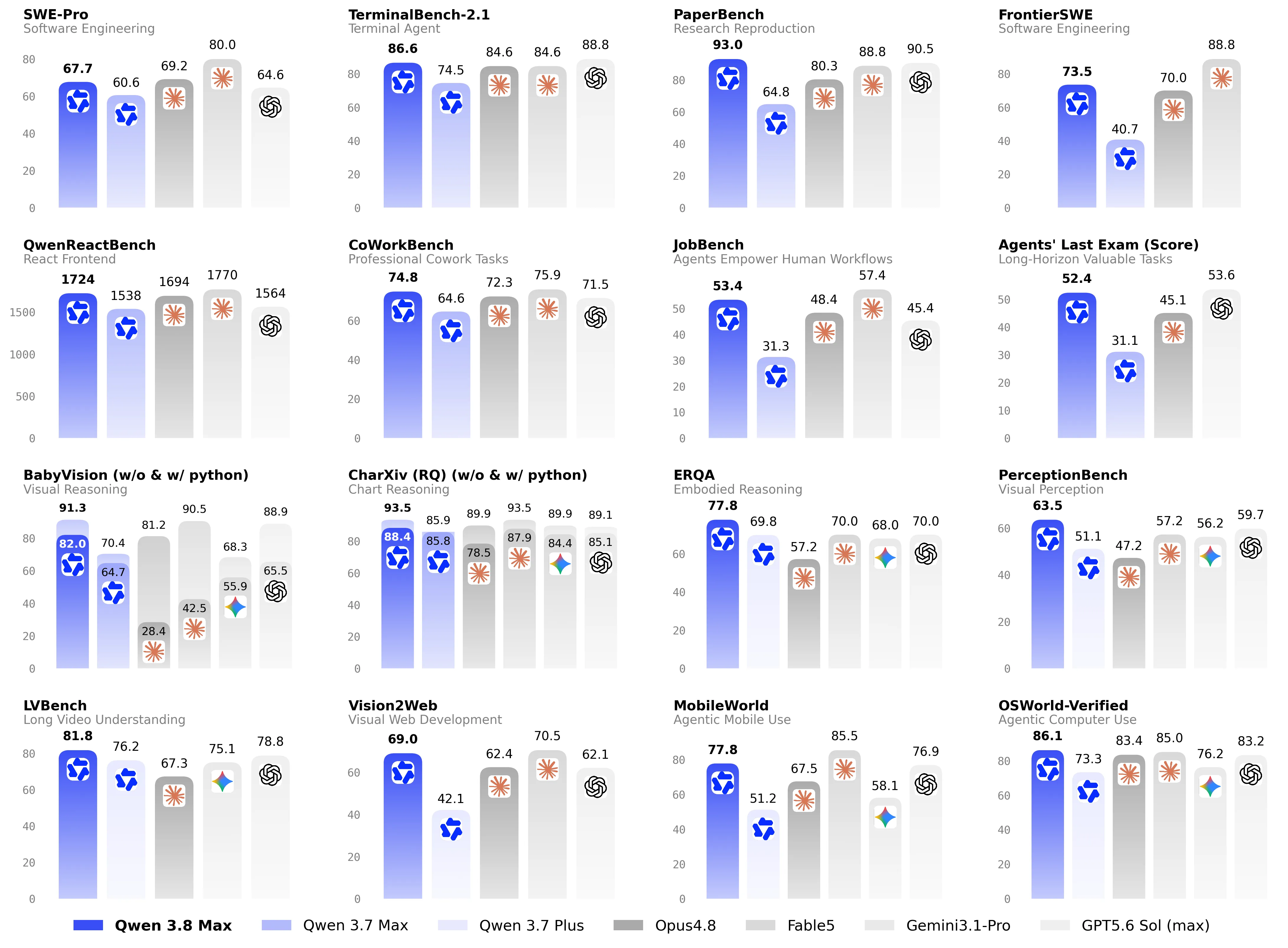
Alibaba's Qwen3.8 Max Tops the Agentic Index
On August 6, Artificial Analysis updated its Agentic Index and ranked Alibaba's Qwen3.8 Max first overall. The story drew 420+ points on Hacker News. In the discussion, someone compared it against Kimi K3 on the same tricky debugging task, saying Qwen built its own diagnostic tools and did solid statistical analysis.
Qwen3.8 Max was officially released on August 3 as the most capable model in the Qwen family. It has 2.4 trillion total parameters with 95B active, and a 1M-token context window. This is the first time Alibaba open-sources weights at Max scale; the weights were promised within a week of release, alongside Qwen3.8-27B. Several HN commenters called the 27B the real news, since Qwen3.6-27B is already a popular choice for local deployment.
On Artificial Analysis' Intelligence Index, Qwen3.8 Max scores 58, versus a median of 33 among comparable models. Pricing is $2 per million input tokens and $6 per million output tokens, with cache hits at $0.25 (an 88% discount).
Three fully autonomous coding demos
The official blog showed three autonomous coding cases with no human in the loop:
First, the model maintained an open-source CLI project (oh-my-cli) from scratch over 10+ days. Requirements entered through GitHub Issues; the model claimed them, wrote code, ran tests, and merged PRs itself. As of July 30, the repo had accumulated 265 commits, 127 PRs, and 151 issues.
Second, it reproduced a research paper on data selection for LLM reasoning. Given only the paper and GPUs, the model wrote about 7,600 lines of code and ran 33 rounds of GPU training over roughly 125 hours, confirming all six main findings (the paper's method beats random data selection by 7.7 points on AIME24). It then ran an 88-hour self-improvement loop, came up with 18 ideas of its own, and pushed AIME24 another 2.7 points past the paper's method.
Third, it entered a Tianchi competition with 526 human teams (multimodal dialogue intent recognition). Within a strict 24-hour limit, the model read the rules, fine-tuned BERT-family models plus Qwen2.5-VL-7B, built a weighted-voting ensemble, and raised accuracy from 0.60 to 0.853 across 45 submissions, beating 458 of the 526 human teams.
Long-horizon tasks and multimodal agents
Qwen3.8 Max also demonstrated chip design: asked to optimize a GCD/RSA cryptographic accelerator, it cut the gate count from 8,298 to 678, shrank the die from 106x106 to 46x46 micrometers (an 81% reduction), and achieved timing closure at 500MHz.
In an e-commerce simulation benchmark (a 365-day operating simulation built on desensitized Taobao/Tmall data), the model finished with a balance of ¥416,252, a 4.16x return on its ¥100,000 starting capital, 38% ahead of second-place GLM 5.2. On the multimodal side it handles PDFs of 200+ pages and videos over 100 hours long. Alibaba also released Qwen-MM-Plugins, letting existing agent harnesses plug in image and video processing.
OpenAI tunes GPT-5.6 Sol and makes Luna free
On the same day, OpenAI announced updates to ChatGPT. For Plus and Pro users, GPT-5.6 Sol in Chat was tuned to give more focused answers with more reliable facts, and a new slider controls how much thought the model puts into each response. The same model now powers both instant replies and deeper reasoning.
The bigger change is for free users: the default model becomes GPT-5.6 Luna, with unlimited text chats. A Think button temporarily calls on higher reasoning for harder questions. OpenAI says a billion people use ChatGPT every week, and the move looks like an attempt to give more compute to the free tier while competing with Google's AI Mode for search-oriented users. One HN commenter called free unlimited Luna a pretty aggressive move.
What to make of these two days
Qwen3.8 Max and free GPT-5.6 Luna landed on the same day, and the direction is similar: competition has shifted from who is smarter to who can do longer, more useful work. Qwen is betting on 2.4T parameters and open weights to prove long-horizon autonomy; OpenAI is using free access to defend its user base. For ordinary users, the quality of what the free tier can do is clearly going up, which is the most tangible change.