Today's Picks
The three projects below all showed up on Hacker News' front page in the past two days. Beyond that they have little in common: an agent platform for teams, a browser engine written from scratch, and a DJ mixer that runs inside your terminal.
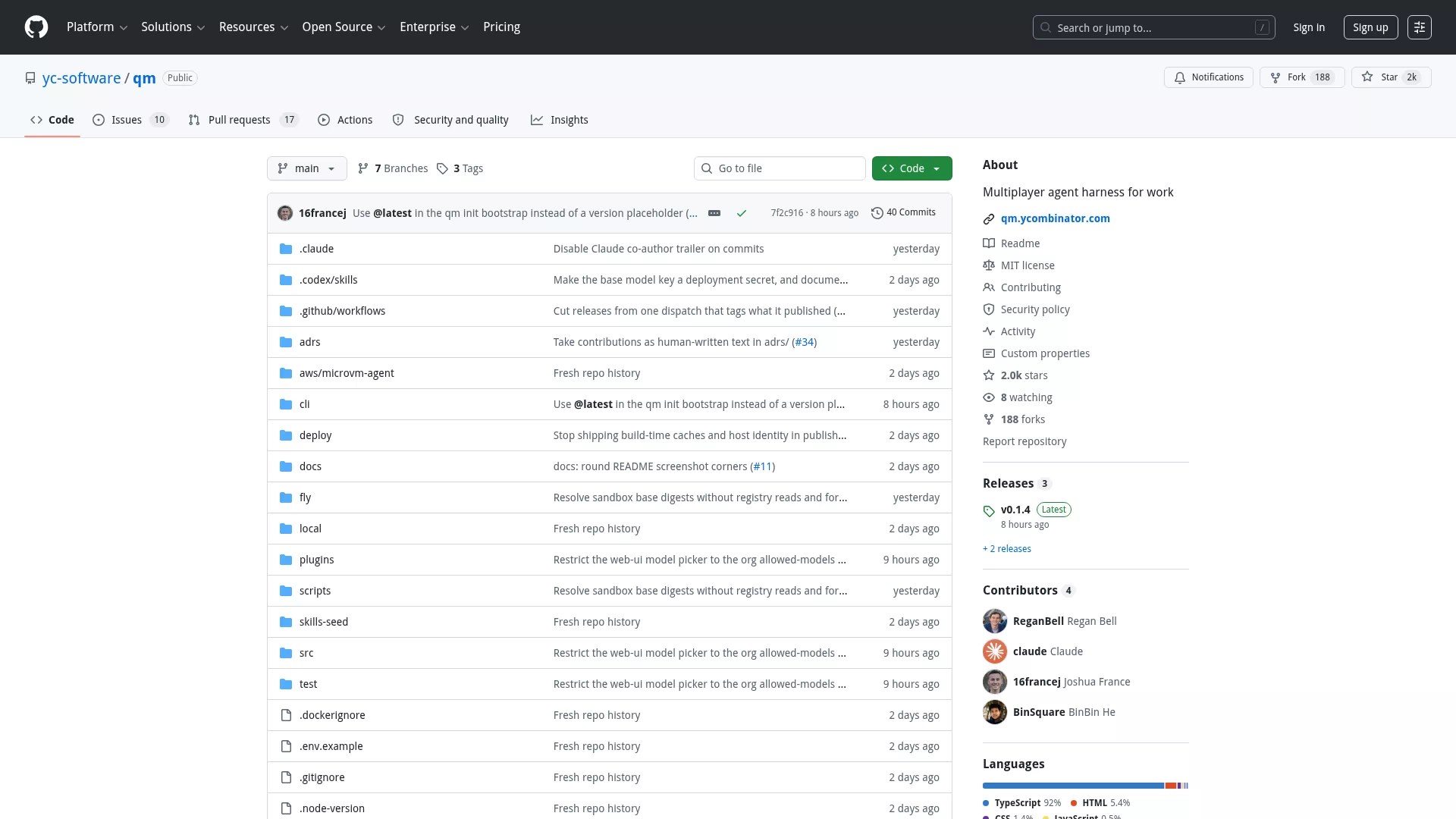
QM: YC's open-source multiplayer agent platform
QM is what Y Combinator open-sourced after running it internally for over a year. It scored 460+ points on Hacker News and passed 2,000 stars on GitHub within two days. It tackles the "one agent serving a whole company" problem: each employee and each project gets an isolated workspace with its own memory, files, and sandbox, while still being able to collaborate with the agent in Slack channels and group messages.
What stands out is that it is not tied to any single model vendor. Pi, OpenCode, Codex, and Claude Code can all drive the same core, and each deployment runs in your team's own cloud account, so data and keys stay under your control. Crons, internal web app publishing, and shareable skills are built in. If you manage a team of AI coding agents, QM is worth a look.
cwbrowser: a browser one person wrote in Zig over two years
cwbrowser's pitch fits in one sentence: the rendering engine is written from scratch, with no Chromium, WebKit, or Gecko. The HTML parser, CSS cascade, layout engine, and paint pipeline are all hand-written in Zig; only the JavaScript VM is borrowed from Google's V8. One person worked on it for two years, it passes Acid3 100/100, and early tests show it roughly 2x faster than Chrome.
This is far from being a daily driver yet, but it proves writing a browser from zero is not a fantasy. The codebase is small enough to read end to end, which makes it great learning material for anyone curious about how browsers actually work.
termixer: DJing from your terminal
termixer is a terminal DJ mixer written in Rust with ratatui: dual-deck faders, 3-band EQ, crossfader, sample pads, and a sequencer. It auto-discovers audio sources like MPV, SuperCollider, PipeWire, and JACK, and pairs with TidalCycles for live performance. Navigation is Vim-style, and installation is a single cargo install termixer.
For developers who live in the terminal, this is a fun toy: you can scratch records without leaving your shell. It has 100+ stars on GitHub and the author is actively maintaining it.
The three projects today cover very different ground — team productivity, low-level engineering, and pure fun. Each has its own audience, and all three are worth a bookmark.