Watchfire: a control room for multiple AI coding agents
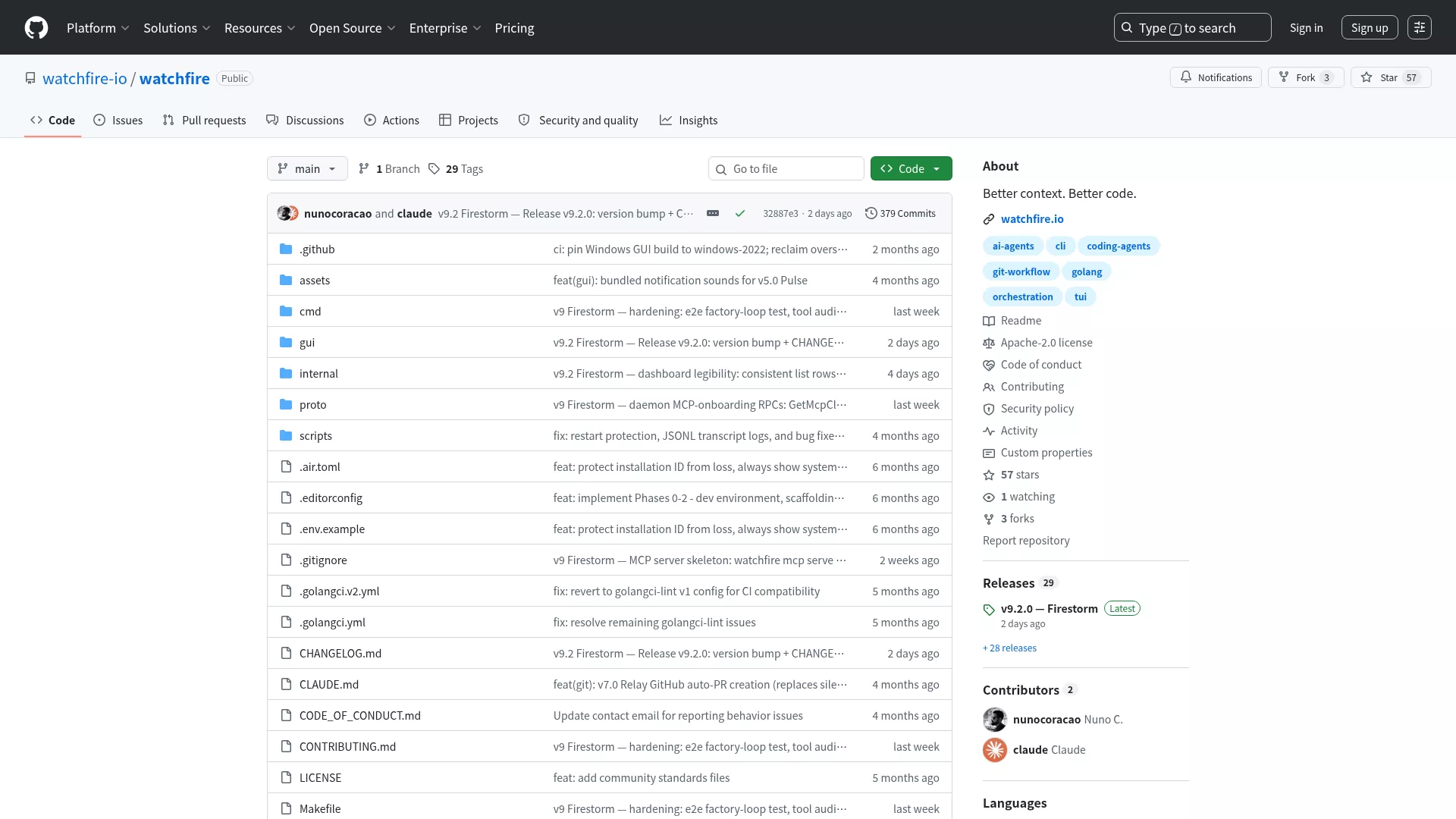
Watchfire is a Show HN project from the last couple of days. The author's original motivation was simple: when running several coding agents at once, he didn't want to click "allow permission" for each one. That grew into a full orchestration tool.
It's open source and written in Go. You define the project structure, break work into well-scoped tasks, and let agents execute with full awareness of the codebase, constraints, and goals. Context is managed automatically, so agents don't lose track of which repo they're in or what they've changed. It ships as a TUI, a GUI, and a daemon; both a desktop app and a CLI are available, installed via a one-liner.
What stands out is that it can expose itself as an MCP server. That means different agents can share context, and one agent's output can become another's input. The repo has 57 stars and is actively updated. It's a good fit if you already use agents like Claude Code or Codex but find a single agent limiting.
Mcpscore: score your MCP servers
The MCP ecosystem's problem right now isn't too few servers, it's uneven quality. A spec-violating server won't crash; it will just make agents pick the wrong tool, drop your server from their registry, or leak traffic quietly.
Mcpscore targets exactly that. Like Lighthouse for web pages, it audits MCP servers against 81 rules and grades protocol conformance, tool quality, and security/auth posture on a 0-100 scale, then tells you what to fix. Rules are weighted by severity; protocol version, TLS, and tool schemas carry the most weight since they affect interoperability.
Usage is simple: pip install mcpscore, then mcpscore https://your-server.example/mcp. It supports STDIO, Streamable HTTP, and SSE transports with auto-detection, and can run as a GitHub Action or be embedded as a library. Scoring is deterministic; no API key or sign-up required.
VPS Price Tracker: compare VPS offers
The most tedious part of buying a VPS is comparing prices. Every provider lays out its pricing page differently, and aligning the same config across vendors takes half a day.
VPS Price Tracker automates that with an automatic crawler pipeline. It scrapes pricing, CPU, storage, and network data from providers, then ranks and filters by price, hardware, and bandwidth, like a search engine purpose-built for VPS. You can start with a broad query such as "4 cores 8G" and narrow it down with budget caps, datacenter location, or bandwidth requirements.
The author calls it a pet project, with data kept fresh by the crawler. If you're starting a new project and want a decent machine at a good price, it saves a lot of manual digging through provider sites.
Wrap-up
All three picks today solve a concrete annoyance: Watchfire keeps multiple agents in line, Mcpscore keeps MCP quality in check, and VPS Price Tracker keeps your budget in check. The first two are open source, the third is free to use; all worth bookmarking.