On September 2, three organizations released their next-generation AI models on the same day. Google launched the Gemini 3.8 Flash series focused on long-horizon software engineering. Alibaba's Qwen team updated Qwen3.8-Max-0902, which now leads the Code Arena programming leaderboard ahead of Claude Opus 5 max. And World Labs released Atlas, a multimodal world model that enables pixel-precise camera-controlled image and video generation plus 3D reconstruction.
Gemini 3.8 Flash: A Reasoning Engine Redesigned for Long-Horizon Tasks
Google released two variants: Gemini 3.8 Flash (general-purpose) and Gemini 3.8 Flash Cyber (cybersecurity-specific). This is Google's third Flash model in six weeks.
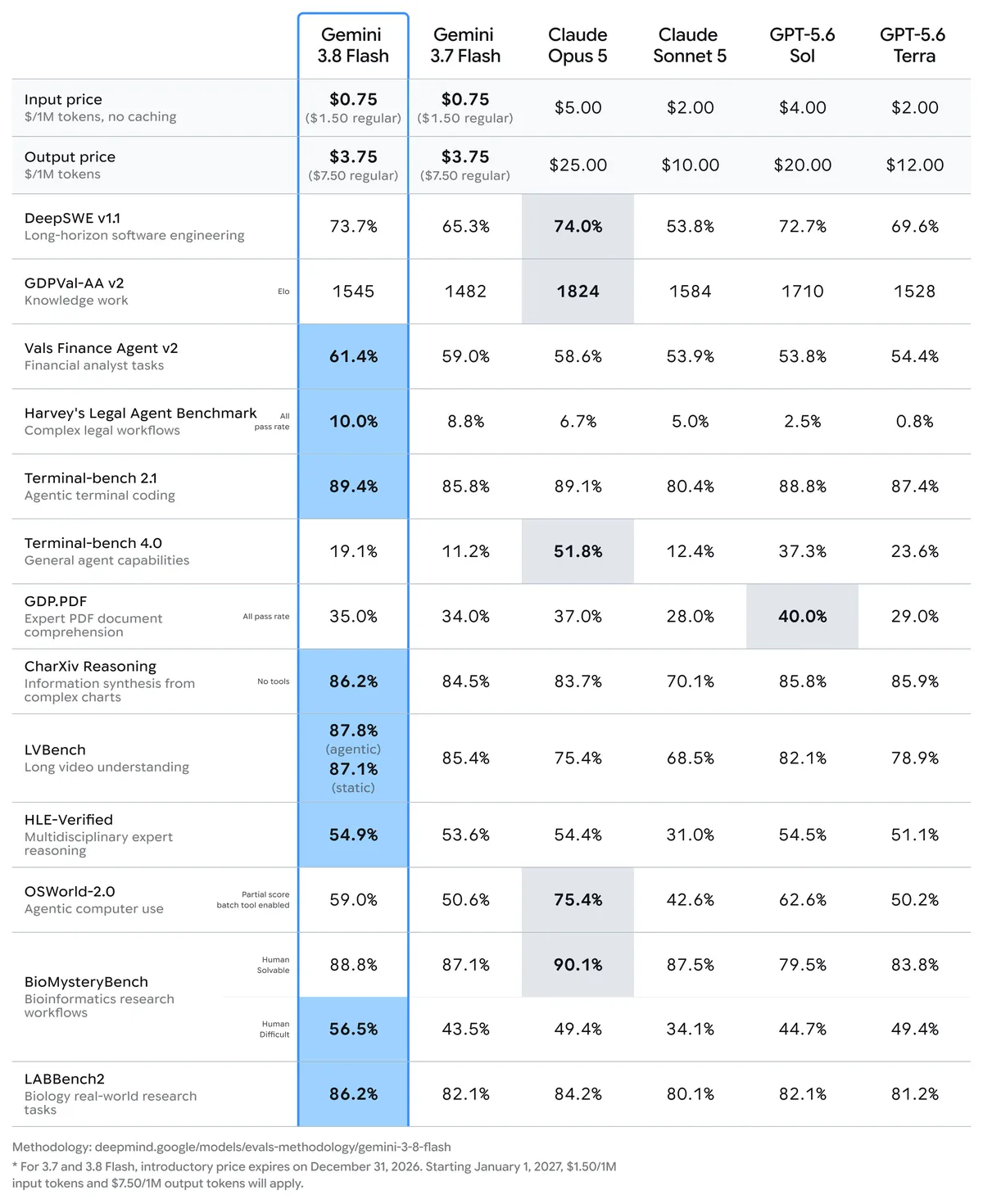
The core improvement in 3.8 Flash is that it "thinks harder." When faced with complex tasks, the model executes more reasoning steps and calls tools iteratively. Google says this produces meaningful gains on long-horizon tasks, though higher thinking intensity may consume more tokens.
Key benchmarks:
- DeepSWE v1.1 (long-horizon software engineering): Outperforms most larger frontier models
- HLE-Verified: 54.9%, covering multi-step reasoning across STEM, humanities, and professional domains
- Vals Finance Agent V2: Surpasses 3.7 Flash in financial analysis
- Harvey's Legal Agent Benchmark: Strong performance in legal tasks
Pricing follows a promotional approach: $0.75/M input tokens and $3.75/M output tokens through end of 2026, doubling to $1.50/$7.50 starting January 1, 2027.
The Flash Cyber variant is designed for cybersecurity scenarios. On CyberGym's autonomous vulnerability discovery benchmark, it surpasses both 3.5 Flash Cyber and significantly larger frontier models. The Cyber version is currently available only through the Fairwind Program to trusted security teams.
The model is live on Gemini API, Google AI Studio, Android Studio, and Google Antigravity. It accepts text, images, audio, and video inputs, with a context window up to 1M tokens and maximum output of 64K tokens.
Qwen3.8-Max-0902: Code Arena Champion, Coding Capability Breaks New Ground
Alibaba's Qwen team also released the 0902 snapshot of Qwen3.8-Max on the same day. This is an upgraded version built on additional post-training focused on coding and professional office scenarios.
In the Code Arena web development leaderboard, Qwen3.8-Max-0902 reached 1691 points, a 22-point improvement that puts it ahead of Claude Opus 5 max. Code Arena's updated Pareto frontier (cost-performance) analysis shows the model's average cost at $5 per million tokens.
Technical specs:
- Context window: 1M tokens (991K max input, 131K max output)
- Pricing: $2/M input, $6/M output
- Input types: Text, images, video
- Features: Function Calling, Web Search, Code Interpreter, Fine-tuning
- Implicit cache read price: $0.25/M tokens
According to Qwen, the 0902 version shows notable improvements in multi-tool orchestration and end-to-end task delivery, with sharper visual understanding for chart reasoning, document parsing, and multimodal perception.
The model is available on the Qwen AI platform and has been integrated into Qwen Office, Qoder, and the Qwen App.
World Labs Atlas: From Image Generation to 3D World Reconstruction
World Labs (Li Fei-Fei's spatial intelligence company) released Atlas on September 1. It is a multimodal world model pretrained from scratch to natively handle text, images, video, and 3D data.
Atlas uses a multimodal autoregressive diffusion transformer architecture, combining all inputs into a shared spatial context for inference.
Core capabilities:
- Camera-Controlled Generation: Generates new views from one or more reference images at any specified camera position and angle, outputting videos up to 1 minute at 1440p resolution
- Spatial Reconstruction: Reconstructs real-world scenes from one to dozens of input images, generating both novel-view image frames and explicit 3D outputs, outperforming specialized 3D reconstruction models
- Space-Time Simulation: Models space and time from input videos, enabling video reframing and Real-to-Sim robotics simulation workflows
- Image Generation: Generates images and 360 panoramas from text, supporting complex prompts and text rendering
World Labs says Atlas performance improves with increased training compute. Some partners already have early access, with broader early access opening in the coming weeks.
Comparison
| Feature | Gemini 3.8 Flash | Qwen3.8-Max-0902 | World Labs Atlas |
|---|---|---|---|
| Provider | Alibaba Qwen | World Labs | |
| Focus | Long-horizon reasoning/coding | Coding/office Agent | Multimodal world model |
| Context | 1M tokens | 1M tokens | N/A |
| Input price | $0.75/M (promo) | $2/M | Not disclosed |
| Output price | $3.75/M (promo) | $6/M | Not disclosed |
| Video gen | No | No | Yes (1440p, 1min) |
| 3D reconstruction | No | No | Yes |
| Cybersecurity variant | Yes (Cyber) | No | No |
| Availability | Public API | Public API | Early access |
Impact
Google and Qwen updated their flagship models on the same day, with competition centering on long-horizon programming and autonomous Agent capabilities. 3.8 Flash outperforming larger models on DeepSWE, and Qwen3.8-Max-0902 beating Claude Opus 5 max on Code Arena, both signal that lightweight Flash-tier models are approaching or surpassing traditional flagship models on specific tasks.
World Labs' Atlas opens a different track entirely. Reconstructing complete 3D scenes from a single image and maintaining pixel-level geometric consistency in video generation—if these capabilities deliver as promised, they would have real impact on robotics simulation, digital twins, and creative tools.