
Overview
On August 26, two Chinese AI companies released major open-source models almost simultaneously. Z.ai open-sourced GLM-5.3-Flash, currently one of the largest open-source MoE models by parameter count. Alibaba's Tongyi team released Qwen3.8-Flash-Next as an early preview of the Qwen4 architecture. Both models use Mixture-of-Experts, both claim大幅 reduction in training costs, and both sparked heated discussion on Hacker News.
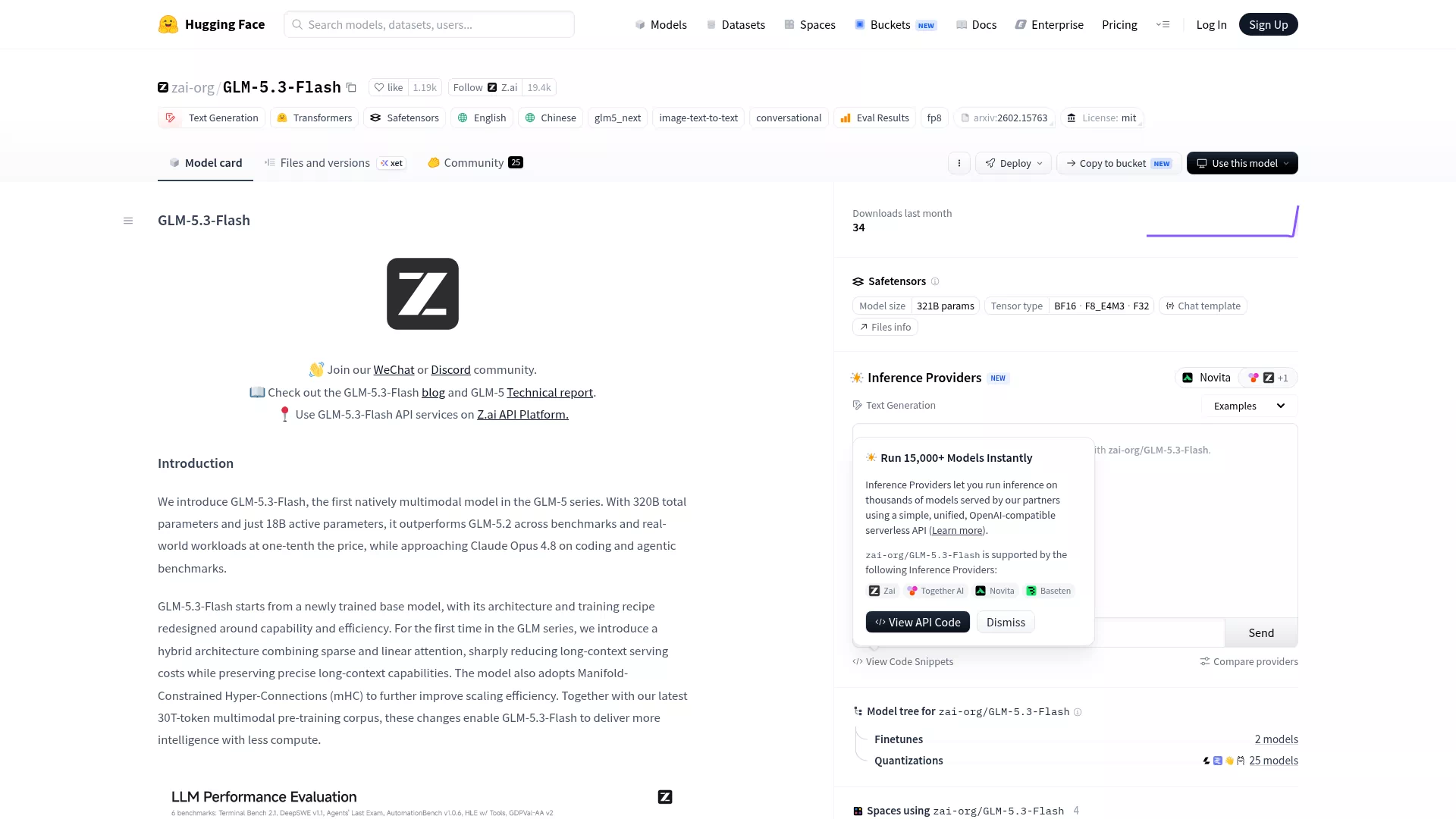
GLM-5.3-Flash: 320B Parameters, 18B Active
Z.ai announced GLM-5.3-Flash on its official blog. The model uses a mixture-of-experts architecture with 320B total parameters, activating 18B per token. It has a 1M token context window, supports text and image input, and outputs text.
Performance and Pricing
Artificial Analysis benchmarks show GLM-5.3-Flash ranks #3 on the Intelligence Index (out of 110 models) with a score of 57, well above the median of 28 for comparable models. Speed-wise, it outputs around 50 tokens/second, slightly below the average of 65.
API pricing is competitive:
| Item | Price (USD) | Price (CNY) |
|---|---|---|
| Input | $0.15/1M tokens | ≈¥1.10/1M tokens |
| Output | $0.50/1M tokens | ≈¥3.65/1M tokens |
| Cached Input | $0.03/1M tokens | ≈¥0.22/1M tokens |
The model is open-sourced under the MIT license, with weights on HuggingFace (zai-org/GLM-5.3-Flash).
The Ox Alpha Mystery Solved
This model has a more interesting backstory. In mid-August, a mysterious model called Ox Alpha appeared on the OpenRouter leaderboard with strong performance but no known identity. Security researchers extracted its system prompt via prompt injection, discovering it was instructed to identify as "ox-alpha developed by an undisclosed organization." Subsequent gzip-NCD compression analysis (a model attribution method based on text compression patterns) matched Ox Alpha's outputs closely with GLM-5.3. A Bloomberg report eventually confirmed: Ox Alpha is GLM-5.3-Flash.
HN discussions note that the model underperforms GPT-5.4 Nano on livebench.ai but surpasses it on certain tasks. Some users speculate it's a smaller model that excels on benchmarks but struggles in real-world scenarios.
Qwen3.8-Flash-Next: Qwen4 Architecture Preview
Alibaba's Tongyi team released Qwen3.8-Flash-Next almost the same day. This isn't a routine model iteration but an early preview of the Qwen4 architecture. The team compared it to Qwen3-Next's role for Qwen3.5: releasing architectural changes early so the community can examine them before the full Qwen4 model family.
Architectural Innovations
Qwen3.8-Flash-Next upgrades along four dimensions:
- Attention: Gated DeltaNet (GDN) + Qwen Sparse Attention (QSA) hybrid. GDN compresses historical information efficiently; QSA uses a compressed lightweight indexer to select important context at micro-block granularity, substantially reducing attention cost on long sequences.
- Residual: Gated Residual (GR) widens the residual stream into 4 branches with dynamic gate control, strengthening cross-layer information flow.
- Embedding: N-gram Embedding scales model capacity via table lookup with minimal extra computation.
- Optimization: Muon optimizer refined around orthogonalization accuracy and the division of labor between Muon and AdamW.
Scale and Performance
The model has 125B main parameters plus 51B N-gram embeddings, activating 6B parameters per token. Official claims: training cost is only about 1/9 of Qwen3.7-Plus, yet it outperforms the latter across coding and office tasks.
HN comments describe this as a "small model punching above its weight." Unsloth has already released GGUF quantized versions for local deployment.
Comparison
| Item | GLM-5.3-Flash | Qwen3.8-Flash-Next |
|---|---|---|
| Publisher | Z.ai | Alibaba Tongyi |
| Total Parameters | 320B | 125B + 51B embeddings |
| Active Parameters | 18B | 6B |
| Context Window | 1M tokens | Not specified |
| Multimodal | Text+Image input | Text+Image input |
| License | MIT | Not specified |
| Training Cost | Not disclosed | 1/9 of Qwen3.7-Plus |
Impact on Open Source
These two releases push the open-source Pareto frontier further into territory dominated by Chinese companies. Artificial Analysis notes that the performance-cost curve for open-source models is now largely defined by Chinese models. GLM-5.3-Flash's MIT license is particularly noteworthy, meaning unrestricted commercial use.
The catch: GLM-5.3-Flash's 320B parameters mean even Q4 quantization needs over 256GB VRAM, making it impractical for individual users. Qwen3.8-Flash-Next's 6B active parameters are more accessible, but its 51B N-gram embedding layer requires additional memory support.
The iteration pace in open-source models is accelerating. From Qwen3.5 to Qwen3.8 took less than a year, and GLM is catching up fast. This pace means any tool or workflow built around a specific model may need frequent updates.