GLM-5.3 Open-Weight Release: Post-Training Driven Coding and Cyber Capabilities
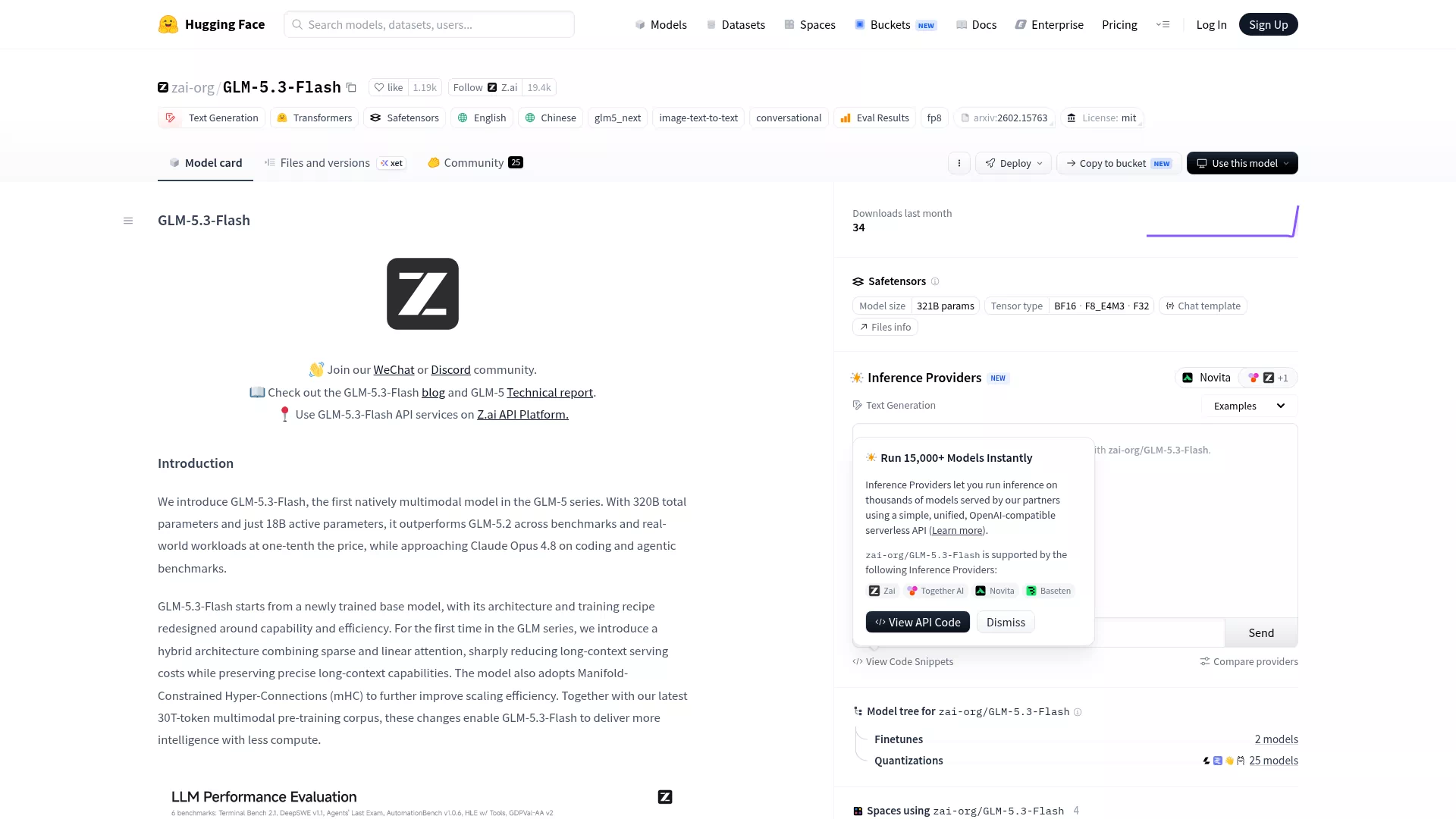
On August 28, Zhipu AI released GLM-5.3 model weights on Hugging Face. First announced on August 14, this model's improvements all come from post-training while sharing the same base as GLM-5.2. With open weights, the community can now deploy locally via SGLang, vLLM, Transformers and other frameworks.
Same Base, Scaled Post-Training
GLM-5.3 and GLM-5.2 share the same base model. Zhipu AI scaled up post-training: more task environments, more diverse task types, more compute. Their post-training stack is called slime, combining Megatron for training and SGLang for inference, allowing math, code, sandbox, verifier and long-horizon task environments to serve as data generation stages.
Three directions were expanded from 5.2 to 5.3. First, tasks moved from coding exercises toward scenarios closer to real engineer workload, some equivalent to days of work for an experienced engineer. Second, vulnerability discovery data was added to training, and cyber capability grew faster than expected. Third, the SAO strategy (long-context RL with compression) was maintained, keeping gains in long-horizon tasks.
Coding: Open-Source SOTA
GLM-5.3 achieved open-source best scores across multiple coding benchmarks:
- Terminal Bench 3.0: 28.3, a 6x improvement over GLM-5.2's 4.6. Surpasses Kimi K3 (17.4) and Claude Opus 4.8 (21.1), but trails GPT-5.6 Sol (34.6) and Claude Fable 5 (33.7).
- DeepSWE v1.1: 66.9, up 45% from GLM-5.2's 46.2.
- Agents' Last Exam: 28.5, ahead of Kimi K3 (27.6) and Claude Opus 4.8 (25.7).
- Terminal Bench 2.1: 88.2, close to GPT-5.6 Sol (88.8) and Kimi K3 (88.3).
On Z.ai Code Bench at Max difficulty, GLM-5.3 achieves 34.5% completion with ~75K output tokens, compared to GLM-5.2's 23.4% at 96K tokens. Claude Opus 4.8 scores 29.5% at 120K tokens, while Claude Fable 5 reaches 39.5%. The improved token efficiency shows post-training raised both the ceiling and efficiency.
Cyber: From Vulnerability Detection to Full Exploit Chains
The most surprising progress appeared in cybersecurity. Zhipu AI added vulnerability discovery data during post-training, expecting better vulnerability identification and analysis. But as training scaled, the model developed capabilities beyond expectations: not just isolated vulnerability detection, but multi-stage reasoning that forms complete exploit chains.
Results on three cyber benchmarks:
- CyberGym (white-box source code vulnerability discovery): 84.5%, 7 points above GLM-5.2's 77.2%. This is the highest among all models tested, surpassing Claude Fable 5 (83.8%) and GPT-5.6 Sol (83.6%).
- ExploitBench (deep exploit reasoning): 54.4%, more than double GLM-5.2's 24.4%. Still behind Claude Fable 5 (78.0%) and GPT-5.6 Sol (76.5%).
- ExploitGym (tasks completed under time budget): 105 tasks in 2 hours, 130 in 6 hours. GLM-5.2 managed only 29 and 39.
The pattern is interesting: benchmarks closer to real attack chains show bigger gains from 5.2 to 5.3, but the gap with closed-source frontier models also widens. The fastest-growing capability is exactly where the gap is largest.
In practical vulnerability discovery, GLM-5.3 found 2,436 vulnerabilities across 269 open-source projects, with 1,097 classified as medium-to-high severity. The oldest vulnerability dates back to 1981, with an average dwell time of 26.6 years.
Deployment and Pricing
With open weights, GLM-5.3 can be deployed locally via SGLang, vLLM, Transformers, KTransformers, Unsloth and other frameworks. Zhipu AI provides TokenSpeed and official cookbooks as references.
Via API on OpenRouter, pricing is $1.40/M input tokens and $4.40/M output tokens, with a 1.31M token context window. The model supports three reasoning effort levels: low, high, and max. High is recommended for coding tasks.
Takeaways
GLM-5.3 demonstrates one thing clearly: post-training scaling still has significant room for improvement even without changing the base model. A 50% coding improvement, emergent cyber capabilities, and better token efficiency all come from the same technical direction. The open-weight release means the community can use and fine-tune this model directly, which is good news for the open-source ecosystem.