Title: Kimi K2.6 Officially Released: Comprehensive Breakthroughs in Long-context Coding and Agent Cluster Capabilities
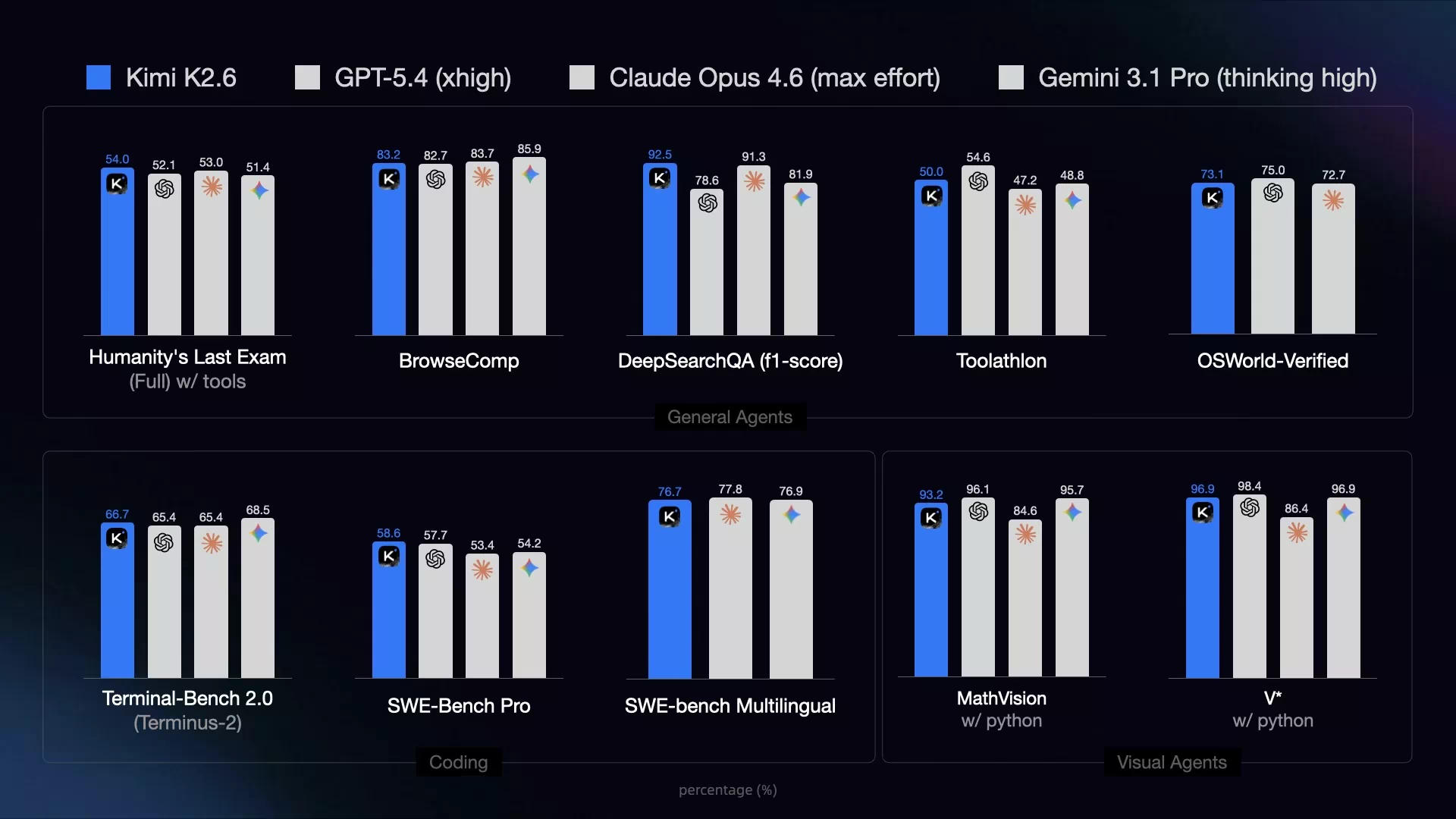
Summary: On April 20, Moonshot AI officially released and open-sourced its latest flagship model, Kimi K2.6. The model achieved significant upgrades in code writing, long-horizon task execution, and Agent cluster capabilities. It performed on par with or better than mainstream closed-source models such as GPT-5.4 and Claude Opus 4.6 in multiple benchmark tests, marking a new stage for domestic large models in complex software engineering and automated task processing.
Slug: kimi-k2-6-model-release-long-coding-agent-cluster
Body:
Last night, Chinese AI company Moonshot AI officially launched its next-generation large model, Kimi K2.6, and announced full open-sourcing. This update is not merely a simple version iteration; it focuses on deep refinement in three core areas: code capabilities, long-horizon task execution, and Agent cluster collaboration.
According to official technical blogs and benchmark test results, K2.6 demonstrated industry-leading comprehensive strength in multiple key evaluations. In the complete version of "Humanity's Last Exam," known for "PhD-level difficulty," K2.6 ranked high with a score of 54.0%. In the SWE-Bench Pro test examining real-world software engineering repair capabilities, its score reached 58.6%, leading all closed-source models. On the DeepSearchQA benchmark evaluating Agent deep retrieval capabilities, K2.6 achieved an impressive 92.5%, significantly surpassing GPT-5.4 and Gemini 3.1 Pro.
Substantial Breakthrough in Long-context Coding Capabilities
The most striking improvement in K2.6 lies in its long-context coding and complex system development capabilities. Official tests show that the model supports uninterrupted coding sessions lasting up to 13 hours, during which it can write or modify over 4,000 lines of code, completing end-to-end development processes from requirement analysis to system optimization. In the rigorous internal code evaluation benchmark, Kimi Code Bench, K2.6's score improved by approximately 20% compared to the previous generation K2.5.
This capability is not just theoretical. The Moonshot AI team shared two practical cases: First, K2.6 successfully deployed and optimized the inference process of a small language model locally. After more than 4,000 tool calls and 12 hours of operation, it ultimately increased inference throughput by nearly 13 times. Second, the model autonomously completed a deep refactoring of an open-source financial matching engine with an 8-year history. Over 13 hours of continuous work, iterating through 12 optimization strategies and precisely modifying over 4,000 lines of code, it achieved a 185% median throughput jump.
Agent Cluster Architecture Upgraded for Scalable Task Processing
The "Agent Cluster" architecture driven by K2.6 has undergone an important upgrade. The new architecture now supports scheduling up to 300 sub-Agents to collaborate in parallel, capable of handling 4,000 collaborative steps simultaneously, achieving significant expansion in task scale and substantial improvement in execution efficiency. This means a single complex task (such as extracting data from research papers, generating visualization charts, and writing long-form analysis reports) can be dynamically decomposed and completed by Agents with different skill specialties, ultimately achieving high-quality end-to-end delivery.
Additionally, K2.6 has enhanced collaboration capabilities with proactive Agent frameworks such as OpenClaw and Hermes, supporting Agents to run autonomously for up to 5 days continuously. This applies to automated scenarios requiring 7×24-hour monitoring, fault response, and system operations.
Integration of Multimodal and Design Capabilities
By deeply integrating code capabilities with visual understanding, K2.6 has reached new heights in code-driven design. The model can proficiently call image and video generation tools to create visually consistent materials, build visually impactful webpage hero sections, and implement rich interactive animations. It is not limited to frontend page development but can also handle basic backend logic, such as embedding form information collection functions in generated webpages, demonstrating potential for full-stack development.
Full Openness and Limited-Time Activities
Currently, the Kimi K2.6 model is fully available on kimi.com, the latest version of the Kimi app, Kimi API, and Kimi Code programming assistant, open to all free users, paid subscribers, and enterprise API users. To celebrate the launch of the new model API, the Kimi Open Platform has simultaneously launched a limited-time top-up bonus activity of up to 30%.
The release of Kimi K2.6, particularly the engineering capabilities demonstrated in long-context coding and large-scale Agent collaboration, provides a new tool paradigm for AI-assisted software development, automated operations, and complex task processing. Its open-source strategy will also further promote the co-construction and development of related technology ecosystems.