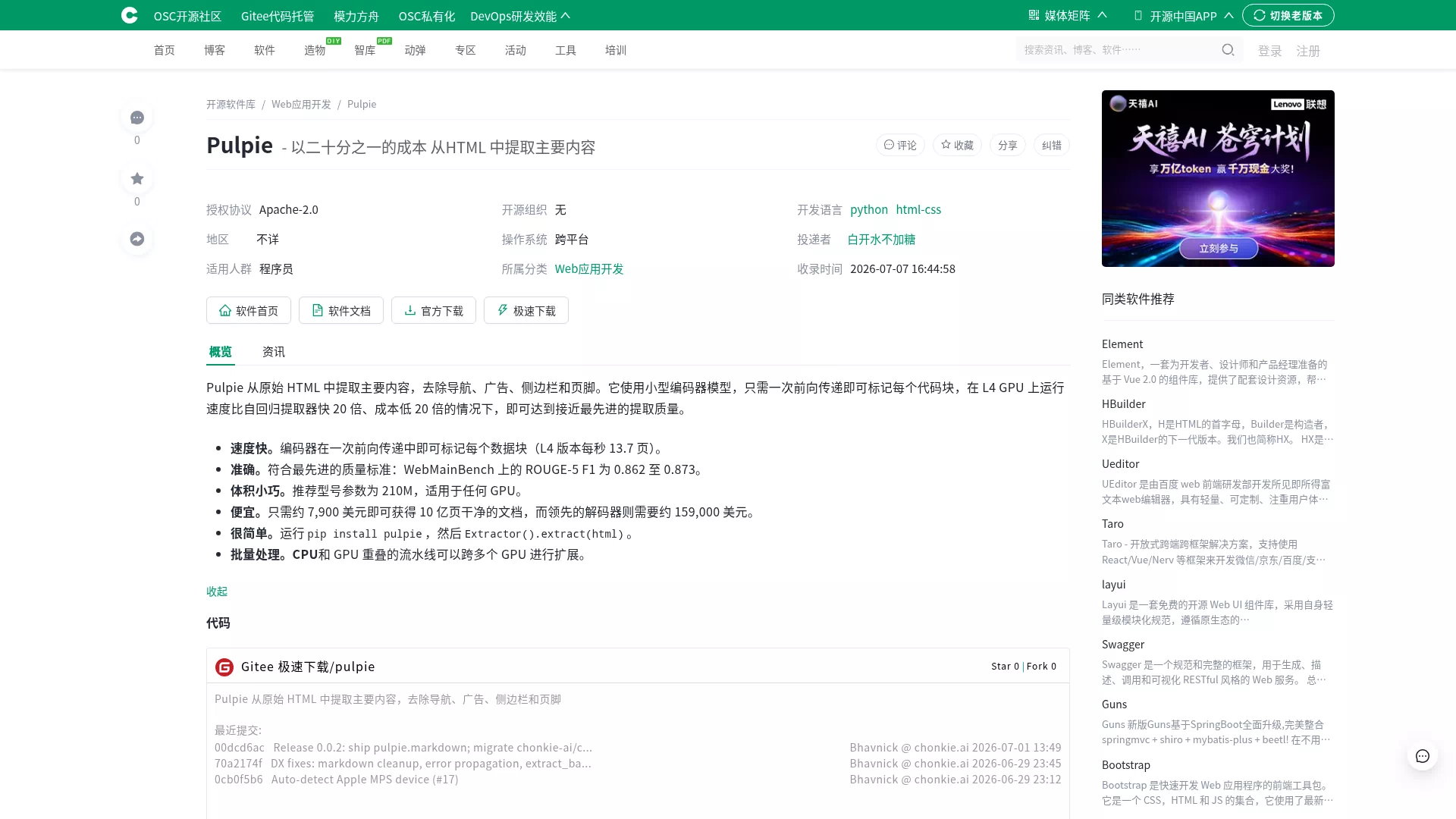
Pulpie: Cheap, Fast HTML Content Extraction
Anyone who works with web scraping knows the pain: extracting the main content from HTML while stripping nav, ads, and sidebars looks simple but is surprisingly hard. Rule engines like Readability and Trafilatura break on non-standard page structures. Autoregressive models improved accuracy but at a high inference cost.
Pulpie takes a different approach — a small encoder model that tags each HTML block in a single forward pass, classifying what is main content. On an L4 GPU it processes 13.7 pages per second, 20x faster and 20x cheaper than autoregressive alternatives. Quality is close to state-of-the-art: ROUGE-5 F1 of 0.862 to 0.873 on WebMainBench.
Install with pip install pulpie, use with Extractor().extract(html). The recommended model has 210M parameters and runs on any GPU. Processing 1 billion pages costs about $7,900 vs $159,000 for a comparable decoder approach.
Karakeep: Self-Hosted Bookmark Manager with AI
Karakeep (formerly Hoarder) is a self-hosted bookmark manager. You run it on your own server so your data stays with you.
It does what you would expect: save links, take notes, store images and PDFs, with automatic title/description/thumbnail fetching. What sets it apart is built-in AI for auto-tagging and categorization. Once you have accumulated hundreds of bookmarks, the search and filtering actually work well.
Comes with a CLI, Chrome/Firefox/Safari extensions, and iOS/Android apps. Sync via floccus, grab video bookmarks with yt-dlp. It is built for the save for later crowd.
OfficeCLI: Office Suite for AI Agents
OfficeCLI solves a specific problem: AI agents need to read and write Word, Excel, and PowerPoint files, but existing solutions either require a full Office install or lose formatting during conversion.
It is a single executable written in C# — no Office needed, zero dependencies, cross-platform. It renders .docx/.xlsx/.pptx to HTML or PNG, letting AI see document content and layout, then write changes back. The built-in HTML renderer handles formatting well.
For teams doing document automation, report generation, or data pipelines, this saves significant integration effort.