


Today's picks from Hacker News cover three different areas: a fresh take on note-taking, a serverless backend alternative, and an on-device writing AI trainer.
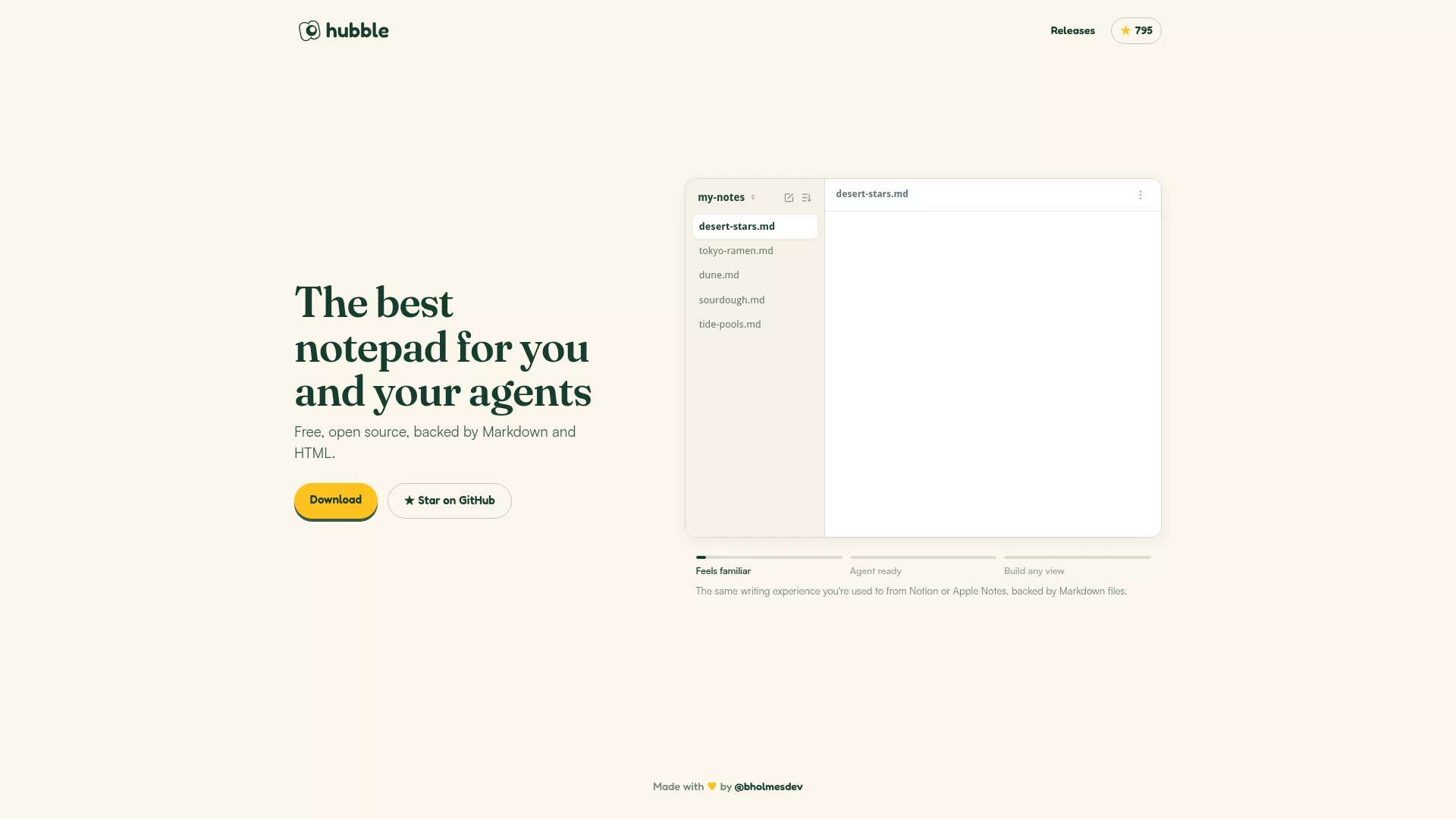
Hubble.md — A Notepad for Humans and Agents Alike
Hubble.md stands out because of its premise: your notes shouldn't be just for you — AI agents should be able to read and write to them too. With 795 stars on GitHub, it's a native macOS app that supports Markdown and HTML.
Instead of a traditional folder tree, Hubble presents your notes in a flat, tiled layout. You tag them with labels and locations — "Kyoto Trip", "Tuscan Bread", "Desert Stars" — more like building a personal wiki than organizing files. On the agent side, it understands these tags and structures, so your AI assistant can categorize, search, and even suggest ideas based on your notes.
It's free, open-source, and has no subscription. If you're using Obsidian or Notion and want your AI helpers to actually understand your note-taking system, give Hubble a try.
Cloudflarebase — Firebase on Cloudflare, Open Source
Firebase is convenient but comes with tradeoffs: vendor lock-in, limited free tier, no easy self-hosting. Cloudflarebase addresses this by reimplementing Firebase's core features — real-time database, auth, file storage — on Cloudflare Workers and Durable Objects, fully open source.
It's built with SvelteKit and uses Better Auth for authentication. For teams already in the Cloudflare ecosystem, this means latency at the edge without managing a separate backend. It's early stage (11 stars on GitHub) but the direction is solid for anyone who prefers the Cloudflare stack over GCP.
Writekin — Fine-Tune an LLM to Write Like You
Writekin solves a specific, relatable problem: every time you ask AI to help write something, it sounds like a generic chatbot, not like you. Writekin lets you fine-tune an open-source LLM locally on your Mac, using your past writing — articles, journals, emails — as training data.
Under the hood, it uses Apple's MLX framework and QLoRA for efficient on-device training. All data stays on your machine, never uploaded. Once trained, the model generates text that mirrors your vocabulary, sentence structure, and even tone. For anyone doing a lot of writing who wants to keep their personal voice, this addresses a real gap in current AI tools.
Currently available for macOS, open source on GitHub.