



GPUHour: Live Cloud GPU Prices, Every Provider
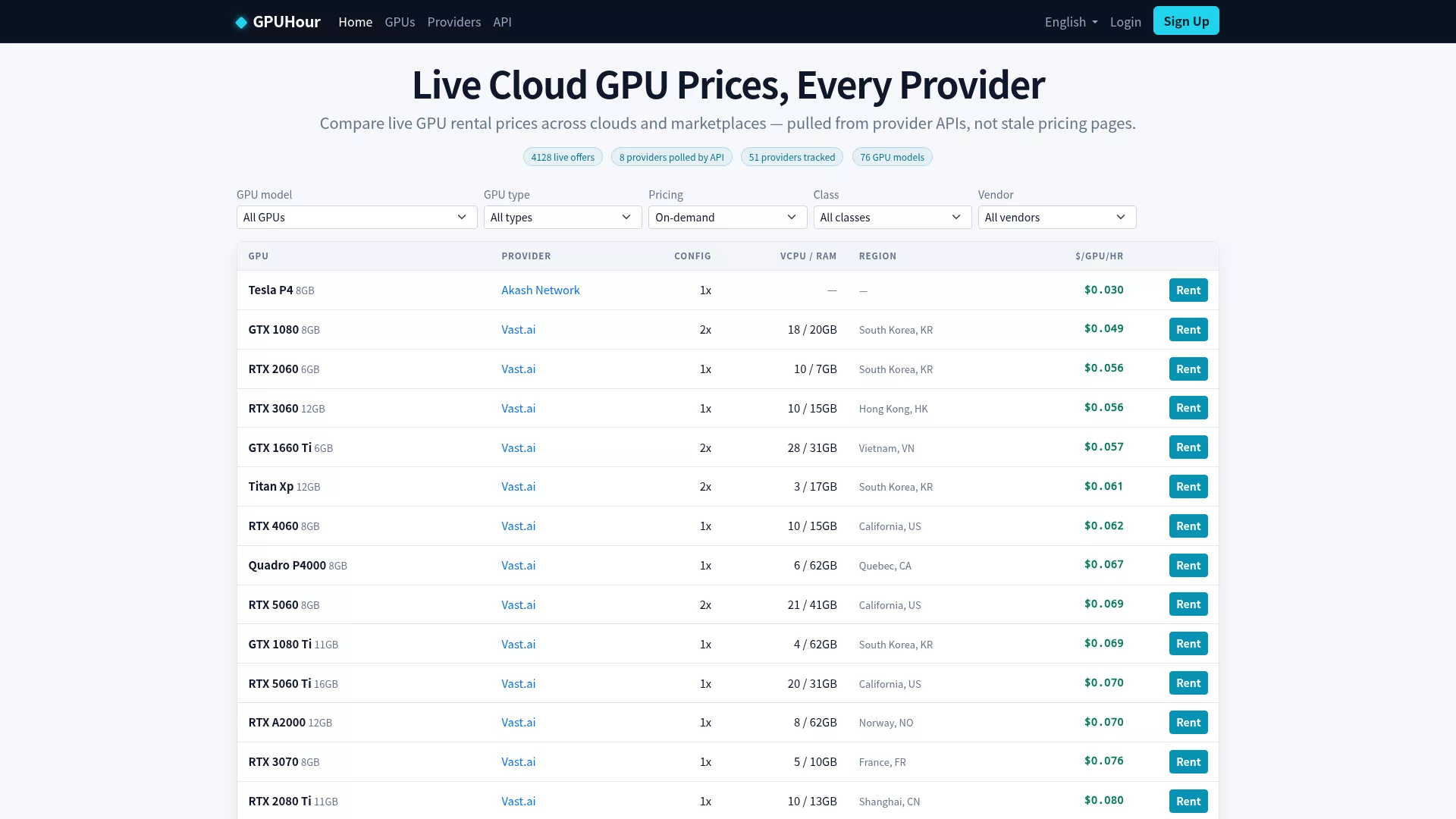
Before training a model, the most annoying part is figuring out how much an H100 actually costs per hour on different platforms. Official pricing pages update slowly, and by the time your script finishes, the bill has already exceeded the budget.
GPUHour turns this into real-time data. It pulls prices directly from provider APIs, covering 51 providers, 76 GPU models, and 4128 live offers. H100, H200, B200, RTX 4090 are all there, with on-demand and spot pricing listed separately and sorted by hourly rate. See a cheap one, hit Rent and jump straight to the provider.
The interface supports dozens of languages including Chinese, and the filters are solid: GPU model, type, class and vendor. For teams that train frequently and don't want to be locked into one platform, this site saves a lot of research time.
SendPage: Turn AI-Generated HTML into a Shareable Link
You wrote an HTML page with Claude or ChatGPT, wanted to send it to a client, and the email client stripped the attachment, or WeChat showed raw source code. Anyone who works with AI has been there.
SendPage solves exactly this. Paste your HTML, it generates a link, and anyone can open the rendered page on their phone with one tap. When you need a formal deliverable, it also exports to PDF, image or Word. Fixed a typo? No need to send a new link, the original link updates.
The free tier gives you 3 documents a month with no signup, and it works smoothly with WhatsApp, Telegram, Slack and email. Pro is $5 a month, suitable for people who regularly send proposals to clients.
Insidedb: Database Internals, Drawn So You Can Watch
The B-tree, MVCC, write-ahead log questions in database interviews are usually explained with text and static diagrams, leaving you with a vague sense of understanding. Insidedb takes a different approach: each mechanism becomes an interactive animation, so you watch data move through the index and transactions roll back in the log.
It starts with the B-tree, then covers the query planner, the WAL and MVCC, four core concepts, each with an interactive demo. No real database engine underneath, just these four ideas running for you to see, which keeps the focus sharp. Good for developers new to database internals, and for a quick review before interviews.
It's open source, hosted on GitHub Pages, open and ready to use.