Google Launches Gemini 3.6 Flash: Cheaper and Smarter
On July 21, Google released Gemini 3.6 Flash, the official successor to Gemini 3.5 Flash. The company also launched Gemini 3.5 Flash-Lite and Gemini 3.5 Flash Cyber alongside it.
Three Models, Three Roles
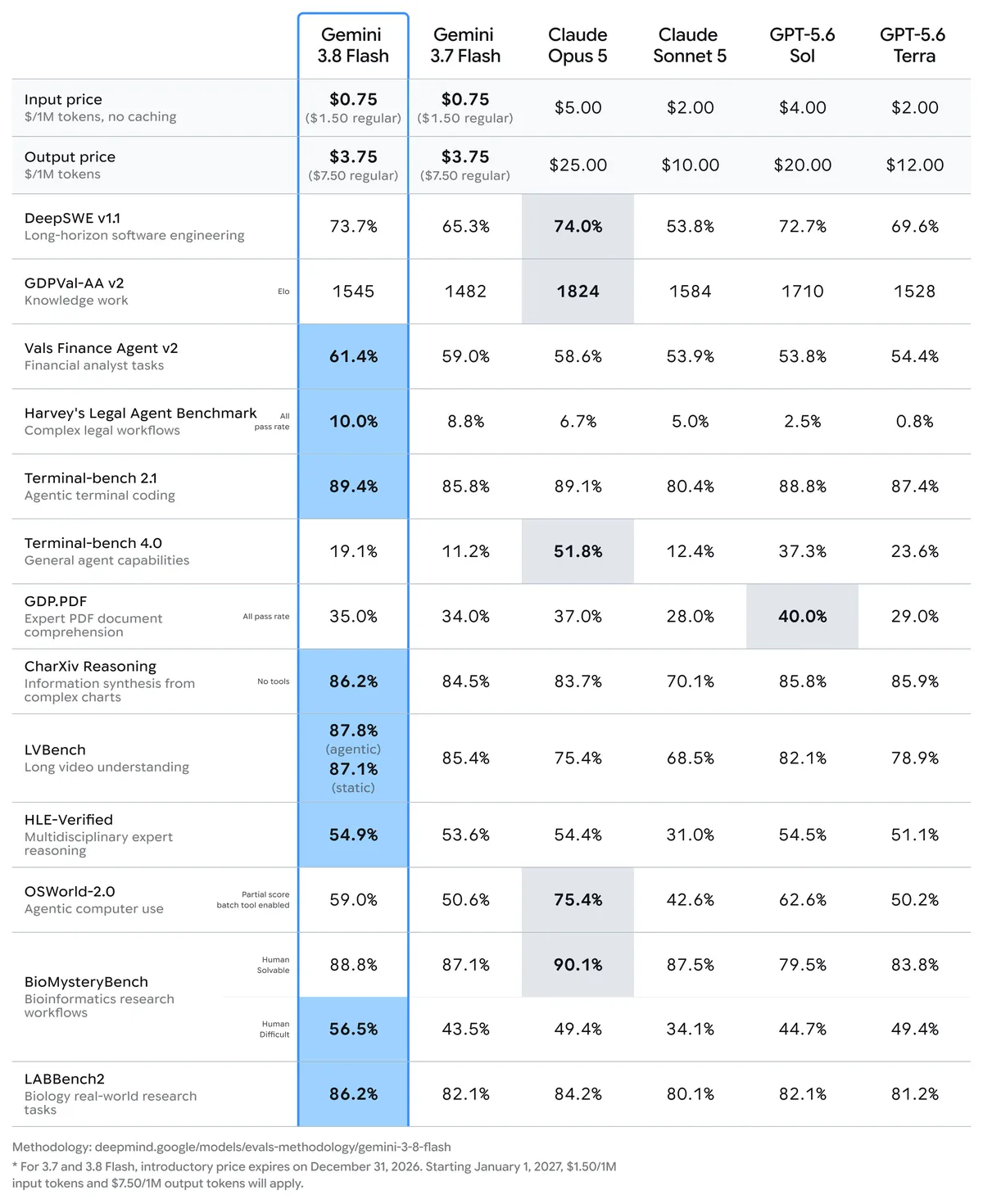
Gemini 3.6 Flash is built for coding, knowledge work, and multimodal tasks. Compared to its predecessor, output token usage is down 17% on average, and the number of reasoning steps and tool calls needed for multi-step tasks has decreased. API input pricing is $1.50 per million tokens, with output pricing dropping from $9 to $7.50 per million tokens.
According to Google's benchmarks, the new model scores 49% on the DeepSWE coding benchmark (up from 37%), and 83.0% on OSWorld-Verified computer-use tests (up from 78.4%). The model is now available on the Gemini app, Gemini API, Google AI Studio, Android Studio, Google Antigravity, and Gemini Enterprise.
Gemini 3.5 Flash-Lite targets high-throughput tasks like agent search and document processing, outputting up to 350 tokens per second. API pricing is $0.30 input and $2.50 output per million tokens.
Gemini 3.5 Flash Cyber is optimized for finding, verifying, and fixing software vulnerabilities. It's currently available in limited testing through CodeMender for government agencies and trusted partners.
Google also confirmed that Gemini 3.5 Pro is still testing with partners, and Gemini 4 has begun pretraining.
Alibaba's Qwen-Image-3.0 Image Generation Model
On the same day, Alibaba released Qwen-Image-3.0, an image generation base model. Its standout feature is support for up to 4.5k token inputs, letting it generate knowledge diagrams blending formulas, geometric shapes, and logic steps alongside complex UI screenshots.
It supports 12 languages and 20+ fonts natively, with readable text down to 10px. It can produce newspapers, storyboards, and exam papers, while also rendering pores and hair strands in detail.
Alibaba also launched a free summer AI course series on the Qwen app, developed with Shanghai Jiao Tong University.
NVIDIA Launches Synthetic Video Detector
NVIDIA introduced the Synthetic Video Detector NIM, aimed at media organizations and individual users. It analyzes video frame-by-frame and scores whether content is AI-generated.
Internal tests show 92% accuracy on uncompressed video, 85% at 15% compression, and 82% at 50% compression. Processing takes as little as 22ms per frame on RTX GPUs and about 30ms on enterprise L40 GPUs.