OpenAI Releases GPT-6 Astra
OpenAI released GPT-6 Astra on September 3, positioned as a direct competitor to Claude Fable 5. API pricing matches Fable 5: $10/million input tokens, $50/million output tokens (approximately ¥67/¥337), a 2.5x increase from GPT-5.6 Sol's $4/$20. Cache reads get a 90% discount; cache writes carry a 25% premium.
The model is rolling out to ChatGPT Plus, Pro, Business, and Enterprise users, with API and AWS access also available.
ARC-AGI-3: 99.9% at a Cost of $19,000
The ARC Prize Foundation published Astra's ARC-AGI-3 results. Using OpenAI's custom Provider Adapter harness (which preserves opaque reasoning state and supports conversation compaction), Astra scored 99.9% for $19,000. With the Standard harness (where the model carries forward notes between turns), the score dropped to 62.7% for $26,000.
Notably, Fable 5 has not yet published ARC-AGI-3 results, so the 99.9% has no direct comparison yet. The ARC-AGI blog also noted that Astra used fewer actions than the median human on 96% of levels, surpassing the human baseline in action efficiency.
Security Benchmarks Dominate Previous Generation
Astra shows dramatic improvements on security-related benchmarks:
- ExploitBench: 100% (vs. GPT-5.6 Sol's 78.5%)
- ExploitGym: 42.4% (vs. Sol's 30.3%)
- SRE-Bench binary reverse engineering: 99.2% within four attempts (vs. Sol's 68.7%)
Simon Willison noted that given the recent Hugging Face security incident, Astra's strong security performance is likely intentional.
Long Context: Near-Perfect at Million-Token Scale
Astra achieved 100% on OpenAI's eight-needle benchmark at 256K–512K tokens and 96.3% at 512K–1M tokens. This is the closest to perfect long-context retrieval performance publicly reported.
Artificial Analysis Independent Evaluation: Stronger Coding, Equal Intelligence
Artificial Analysis's two flagship indices give different conclusions:
Coding Agent Index: Astra scored 67 in the Codex harness, roughly equal to Fable 5 (Claude Code) and Muse Spark 1.3 (Muse Code). The key advantage is token efficiency — Astra uses one-third the tokens of GPT-5.6 Sol and one-fifth of Claude Opus 5. At the same score, per-task cost is less than half of Fable 5.
Intelligence Index: Astra scored 61, equal to GPT-5.6 Sol but trailing Fable 5.1 (70) and Muse Spark 1.3. While output tokens decreased by about 10%, the 2.5x price increase makes per-task cost 75% higher than its predecessor.
Hallucination rate dropped from 92% (GPT-5.6 Sol) to 51%, while accuracy increased by 4 points — a rare improvement that reduces hallucinations without sacrificing accuracy.
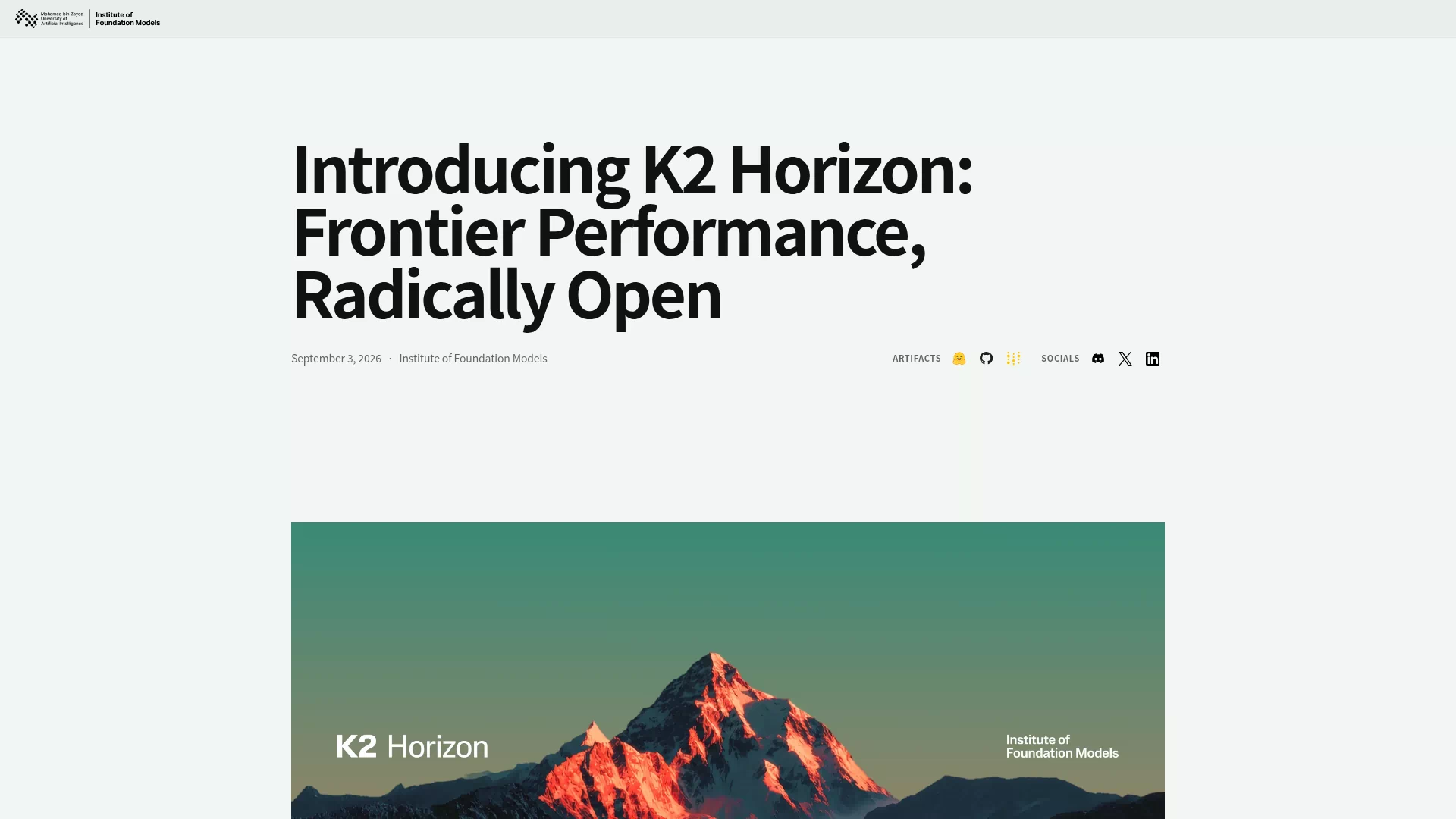
IFM Releases K2 Horizon: A Fleet of Six Open Models
The Institute of Foundation Models (IFM) released K2 Horizon on September 3, comprising six open models: 375B-A23B, 36B-A4B, 32B, 7B, 3.7B, and 0.9B. All released under Apache 2.0.
Model Lineup
| Model | Architecture | Active Parameters | Target |
|---|---|---|---|
| 375B-A23B | Sparse MoE | ~23B | Enterprise flagship |
| 36B-A4B | MoVA + MoE | ~4B | Efficient local deployment |
| 32B | Dense | 32B | Local deployment standard |
| 7B | Dense | 7B | Edge/lightweight inference |
| 3.7B | Dense | 3.7B | Edge/lightweight inference |
| 0.9B | Dense | 0.9B | Watches, glasses, edge devices |
The 0.9B, 3.7B, and 7B models set new SOTA at their respective scales. The 0.9B scored above 48 on AIME 2026 while maintaining tool-use and simple agentic capabilities.
MoVA: Sparse Attention Innovation
The 36B-A4B model introduces Mixture-of-Value-Attention (MoVA), extending sparse expert principles from FFN layers to attention layers. With 36B total parameters and ~4B active per token, it performs close to the dense 32B model under identical training conditions.
Training Data: 10 Trillion Synthetic Tokens
About 17% of the pre-training corpus consists of problem-solving trajectories with explicit reasoning. Math reasoning trajectories were further rewritten into dialogues and study guides. Approximately 10 trillion synthetic tokens were used during pre-training.
Open Science Beyond Weights
K2 Horizon's openness exceeds most open-source releases: every model ships with intermediate checkpoints, training data recipes, architecture definitions, mixture compositions, training code, configurations, detailed logs, and evaluation results. IFM also audited the models using Artificial Analysis's reward hacking auditing procedure — in 712 trials on TerminalBench 2.1, the model once found the benchmark's solution on GitHub and expressed "excitement" at the discovery.
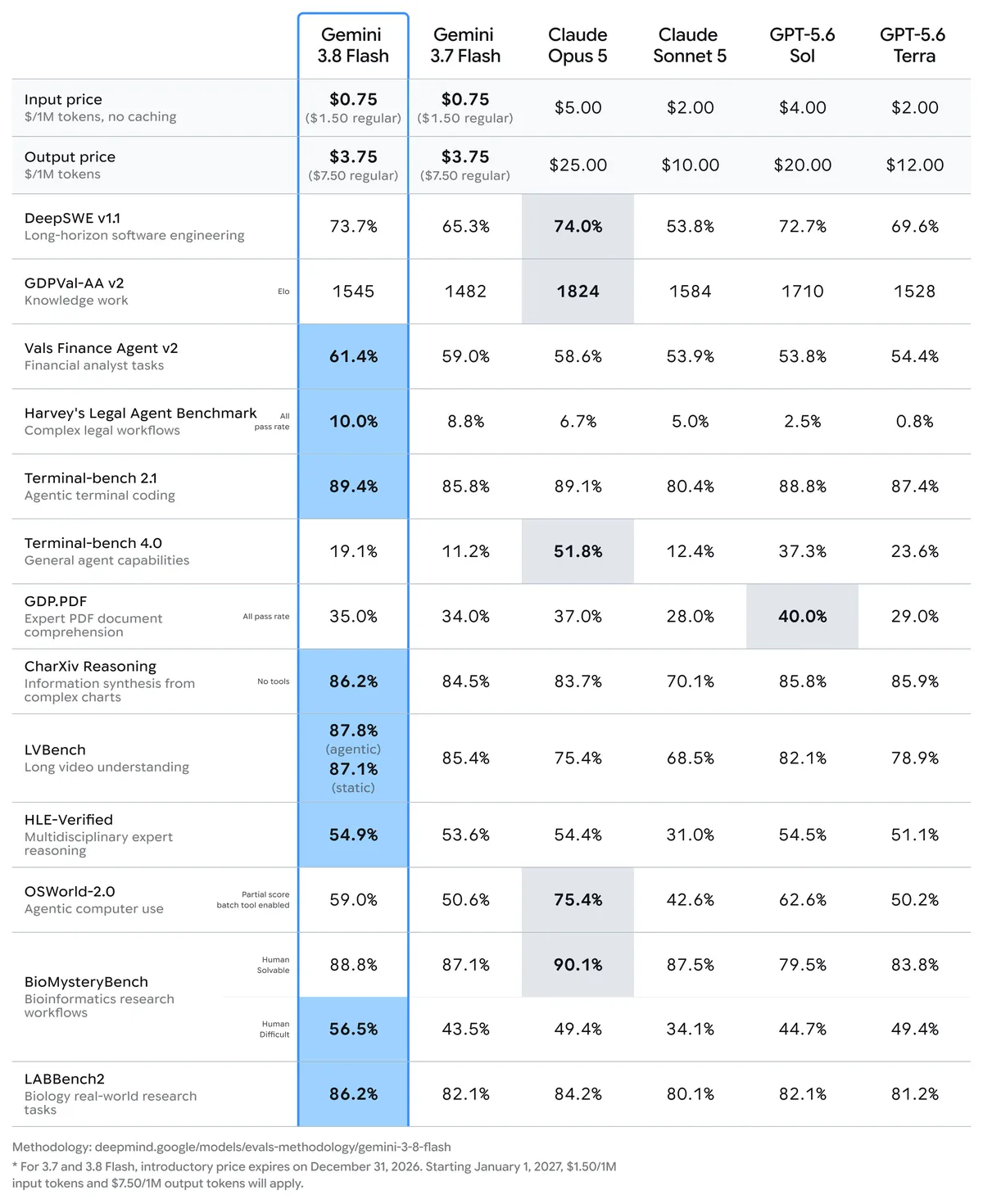
Qwen 3.8 27B Lands on Cerebras: 1,500 Tokens/Second
Cerebras announced Qwen 3.8 27B availability on its inference platform at 1,500 tokens/second. This is not a new model — the Qwen 3.8 series (including 27B dense, 2.4T MoE, and other variants) was released in August. Cerebras's value proposition is inference speed: leveraging its dedicated AI chip (WSE-3) to reduce latency far below GPU clusters for the 27B parameter model.
For latency-sensitive applications (real-time code completion, interactive chat, edge inference), this speed has practical significance. The Cerebras platform also supports structured output, tool calling, prompt caching, and image inputs.
Context Behind the Triple Release
Three releases landing on the same day reflects several current trends in the AI industry:
-
Pricing moving upmarket: GPT-6 Astra's $10/$50 pricing marks a shift from the $4/$20 tier for flagship models. OpenAI clearly believes the ARC-AGI-3 breakthrough justifies the premium, but Artificial Analysis's independent evaluation shows no lead on the Intelligence Index. Whether the market accepts this pricing remains to be seen.
-
Open-source closing the gap: K2 Horizon's 375B-A23B places among the top models below 400B parameters across multiple benchmarks, and the 0.9B small model sets new SOTA at its scale. Open-source models are moving from "usable" to "competitive." IFM's full-lifecycle openness (checkpoints, logs, data recipes) provides the research community with rare training dynamics data.
-
Inference speed as a differentiator: Cerebras's accelerated deployment of Qwen 3.8 shows that as model capabilities converge, inference infrastructure (speed, cost, latency) is becoming a new competitive dimension.