Introduction: The Crossroads of Open-Source AI Agents
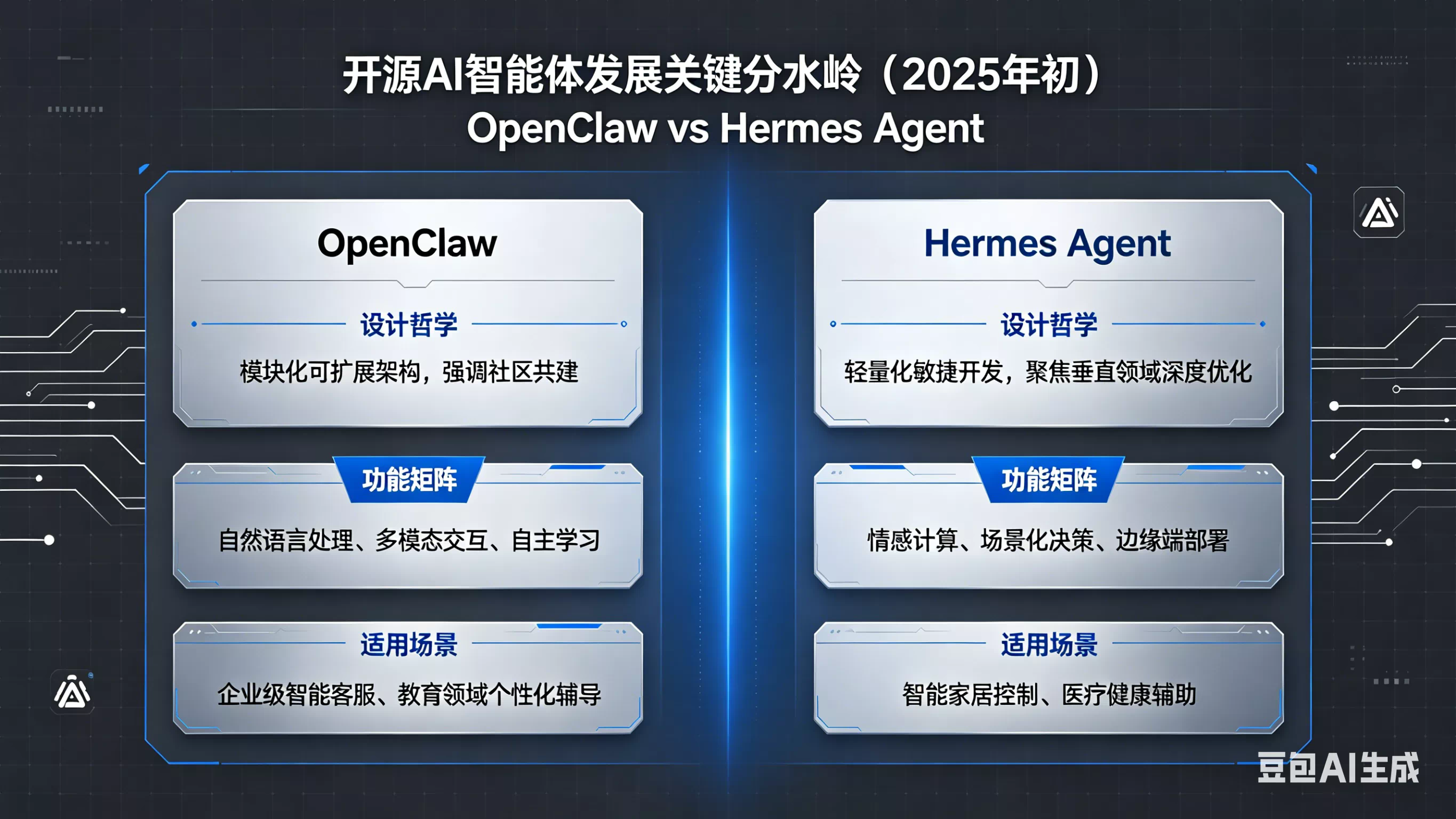
In early 2025, the development of AI Agents reached a critical watershed. On one side stands OpenClaw (with over 340k GitHub Stars), which has become the benchmark in the open-source agent field by pursuing ultimate functional richness and a mature, comprehensive ecosystem. On the other side is Hermes Agent (released by Nous Research), which has rapidly gained popularity with its unique design philosophy, its GitHub Stars soaring to tens of thousands in a short period, and is seen by many in the community as "the first true competitor to OpenClaw."
The emergence of these two is not a simple substitution but represents two distinct evolutionary paths for agents: one is the human-centric control plane (OpenClaw), and the other is autonomous evolution driven by a learning loop (Hermes Agent). This comparison is, at its core, a contemplation on the "future form of AI assistants."
Hermes Agent Core Features: Beyond Tool Calling
The design philosophy of Hermes Agent is clearly oriented towards "Self-Evolving." This means the agent can create and optimize skills during operation and build persistent user memory models, aiming to become a long-term, personalized digital companion.
-
Built-in Learning Loop: This is its most fundamental difference. The Agent can learn from each interaction, automatically generate reusable Skills, and continuously optimize them in subsequent calls. This is fundamentally different from the traditional Agent model of "starting from scratch with every restart."
-
Multi-Layer Persistent Memory System: Its memory architecture is far more than simple chat history storage. It includes: Compact Persistent Memory (retains key context across sessions), SQLite Retrievable Session History, Skill Procedural Memory (records task execution paths), and an optional Structured User Modeling Layer. This lays the foundation for a long-term, coherent assistant experience.
-
Out-of-the-Box Safety & Scheduling: It comes with safety features by default, such as dangerous command approval, user authorization mechanisms, and containerized sandbox isolation. Additionally, the built-in Cron scheduler allows users to describe scheduled tasks in natural language without needing to set up an external scheduling system.
-
Unified Multi-Platform Gateway & Flexible Deployment: A single
hermes gatewayprocess can serve multiple communication platforms like Telegram, Discord, and Slack simultaneously. It supports various deployment methods, from a $5/month VPS to "sleep-wake" capable Serverless options (like Modal), aiming for cost-effective, always-on operation.
Hermes Agent vs OpenClaw: Comprehensive In-Depth Comparison
1. Fundamental Differences in Design Philosophy
- OpenClaw: Employs a Control Plane First strategy. The human is at the center of the decision chain, and all operations typically require explicit authorization. Its identity system is driven by files (like SOUL.md, AGENTS.md), rules are human-defined, and the Agent faithfully executes them. It is more like a powerful but finely-tuned "Swiss Army Knife."
- Hermes Agent: Prioritizes the Learning Loop. The core goal is to build a closed-loop system capable of autonomous iteration and upgrade. The Agent is designed to understand the user better over time, with a higher degree of automation, though transparency and controllability are somewhat traded for this automated evolution capability. It aspires to be a "growing" companion.
2. Feature Matrix Comparison
| Feature Dimension | OpenClaw | Hermes Agent |
|---|---|---|
| Deployment | Primarily local operation | Local / VPS / Serverless, more flexible |
| Memory System | Primarily relies on Markdown file storage | SQLite + Multi-layer memory architecture, supports full-text search & long-term recall |
| Skill Generation | Primarily relies on mature, manually written Skills, vast ecosystem | Supports auto-generation + manual intervention, emphasizes learning from experience |
| Safety Mechanisms | Requires significant manual user configuration | Built-in sandbox & approval flow by default, higher out-of-the-box security |
| Scheduled Tasks | Relies on Cron Skill implementation | Built-in scheduler, can be configured directly with natural language |
| Terminal UI (TUI) | Basic | Feature-complete, supports multi-line editing, slash command completion, etc. |
| Code Architecture | Multi-language/framework hybrid | Pure Python implementation, higher code readability & transparency |
| Community & Ecosystem | Extremely vast (Stars >340k), rich in skills & plugins | Rapidly growing (Stars >46k), extremely fast iteration (major version ~every 3-5 days) |
| Audit & Dashboard | Provides audit command & visual dashboard | Currently lacks systematic security audit features, no graphical panel, relies mainly on CLI |
3. Practical Performance & Experience Differences
- Speed & Overhead: Due to built-in background processes for learning and memory organization, Hermes Agent's response speed is typically slightly slower than OpenClaw's. This is the extra computational cost for its "self-evolving" capability.
- Operation Transparency: Both provide logs when executing operations, but Hermes's display is more intuitive, listing each terminal command and file write action in real-time, which is a major advantage for users needing deep monitoring of Agent behavior.
- Configuration Management: Hermes uses a
.envfile to centrally manage all API keys, with a clear configuration structure (~/.hermes/directory), considered by many developers to be cleaner and easier to maintain than OpenClaw's configuration approach.
4. How to Choose? Use Case Analysis
-
Choose Hermes Agent when:
- You need a personalized assistant that can run long-term, accumulate experience, and become more proficient with use.
- You value out-of-the-box security and automated scheduling and don't want to spend significant time configuring basic security.
- You prefer a pure Python architecture and desire higher code readability and system trust.
- Your use case requires complex memory and contextual association across sessions.
-
Choose OpenClaw when:
- You require fully local, data-offline deployment.
- You are a power user seeking ultimate customization flexibility and control, willing to invest configuration time.
- You heavily rely on the existing vast, mature skill ecosystem to solve specific problems.
- You highly value the built-in audit features and security dashboard, needing comprehensive visual monitoring of Agent behavior.
- Your primary tasks involve browser automation, fine-grained file operations, etc., requiring high response speed and direct system control.
Convergence & Future: Complementary, Not Replacement
Interestingly, the community has already begun exploring practices that combine the strengths of both: using Hermes Agent as the "command center" responsible for memory management, preference learning, and task planning; and using OpenClaw as the "execution terminal" leveraging its rich skill ecosystem for specific operations. This architecture plays to each one's strengths and may represent a development direction for complex agent systems.
Quick Start with Hermes Agent
The installation process is extremely simple:
curl -fsSL https://raw.githubusercontent.com/NousResearch/hermes-agent/main/scripts/install.sh | bash
For OpenClaw users, Hermes thoughtfully provides a migration tool:
hermes claw migrate
This can migrate settings, memories, skills, and API keys with one command, lowering the switching cost.
Conclusion
The rise of Hermes Agent is not intended to replicate or replace OpenClaw but to open a new track in the open-source AI agent field: from "execution tool" to "learning partner." Its deep investment in self-evolution mechanisms, persistent memory, and out-of-the-box security responds to the market demand for smarter, more personalized, and more "hassle-free" digital assistants.
Meanwhile, OpenClaw, with its unparalleled ecosystem scale, localization advantages, and fine-grained control capabilities, will likely remain the first choice for many core users and specific scenarios in the foreseeable future. The ultimate winner of this contest might be the entire developer community—because competition drives faster innovation, more choices, and clearer product positioning. For explorers, the best approach might be to experience both firsthand and choose the evolutionary path best suited for their "digital colleague" based on actual needs.