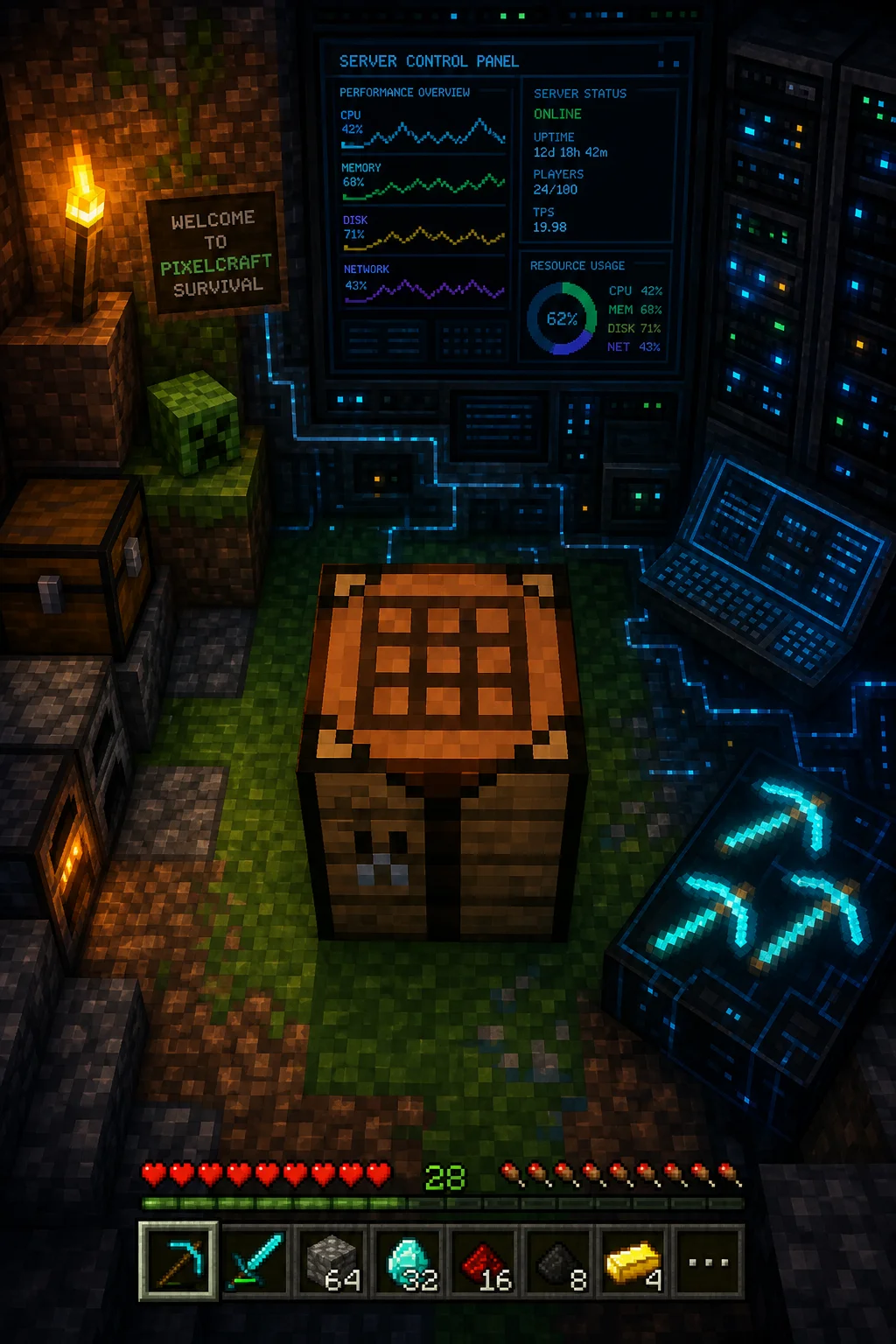

The fun of playing Minecraft lies in creation, but maintaining a server is a different matter. Selecting the core, configuring plugins, tuning the JVM, handling latency, resolving anti-cheat compatibility—each step can keep you busy for ages. Not to mention the differences between Java Edition and Bedrock Edition; beginners alone need to dig through piles of documentation just to understand the difference between Paper and Purpur.
I've compiled the pitfalls I've encountered over the years into a Claude Code Skill: minecraft-server-ops. Put simply, it lets AI handle the ops work: you speak, it acts.
What It Can Do
Server Setup
Supports Paper, Purpur, Fabric, Forge, BDS, LiteLoader. Tell AI your hardware specs and intended use, and it will recommend a suitable core and provide setup steps.
Plugin & Mod Management
Installation, configuration, and conflict troubleshooting workflows are built-in. There's also a plugin list I've personally verified—LuckPerms for permissions, WorldGuard for land protection, GrimAC for anti-cheat, Spark for performance monitoring, and Geyser so Bedrock players can join too.
Performance Tuning
TPS dropped? Memory overflowed? GC logs full of red? The Skill gives targeted advice based on your server type. For example, Packet-Limiter in Paper 1.21 defaults often mistakenly hit projection mods like Litematica; it knows how to tune them to a reasonable range.
Backup & Recovery
3-2-1 backup strategy + automated scripts, complete with disaster recovery steps.
Security Protection
Offline mode fake login prevention, DDoS mitigation, GrimAC false positive reduction. Especially the compatibility issue between GrimAC and Litematica—adjusting 4 parameters makes it work effortlessly; I spent ages debugging this before figuring it out.
Troubleshooting
Startup errors, TPS dropping to single digits, memory slowly filling up, players unable to connect—every scenario has a troubleshooting path. The core idea is the binary search method to disable plugins and quickly locate the culprit.
RCON Remote Control
This part took the most time. An RCON client written purely with the Python standard library, requiring no third-party packages, compatible with both Java and Bedrock editions.
# View server status
python scripts/mc-rcon.py status

# Interactive mode, just like typing commands in the background
python scripts/mc-rcon.py -i

# JSON output, convenient for script integration
python scripts/mc-rcon.py --json online
Online player count, TPS, broadcasts, whitelist, kicking/banning—all common operations are encapsulated.
Why Make It a Skill
Writing documentation is simple; using it is hard. When TPS crashes, no one wants to flip through thousands of words of Wiki to find the relevant section. The Skill understands what you say directly and helps you troubleshoot step-by-step according to the diagnostic process. You type /tps in-game, and it analyzes for you in the terminal.
Installation
git clone git@github.com:xgd16/minecraft-server-ops.git ~/.claude/skills/minecraft-server-ops
After installation, just state your requirements directly in Claude Code:
- "Help me set up a Paper 1.21.4 server with 8G RAM"
- "TPS is only 15, help me see what's dragging it down"
- "How to configure GrimAC to avoid false positives on projection mods"
- "Automated backup at 3 AM daily, help me write a cron job"
The project is fully open source on GitHub. If you maintain Minecraft servers, or want to see how a Claude Code Skill is written, feel free to try it out. If you encounter issues, please file an issue directly.