Three tools trending on Hacker News recently: a terminal emulator with serious speed claims, a toolkit that turns the everyday internet into agent-callable tools, and a Rust scraper positioned as a Firecrawl alternative.
Shitty: stupid name, genuinely fast
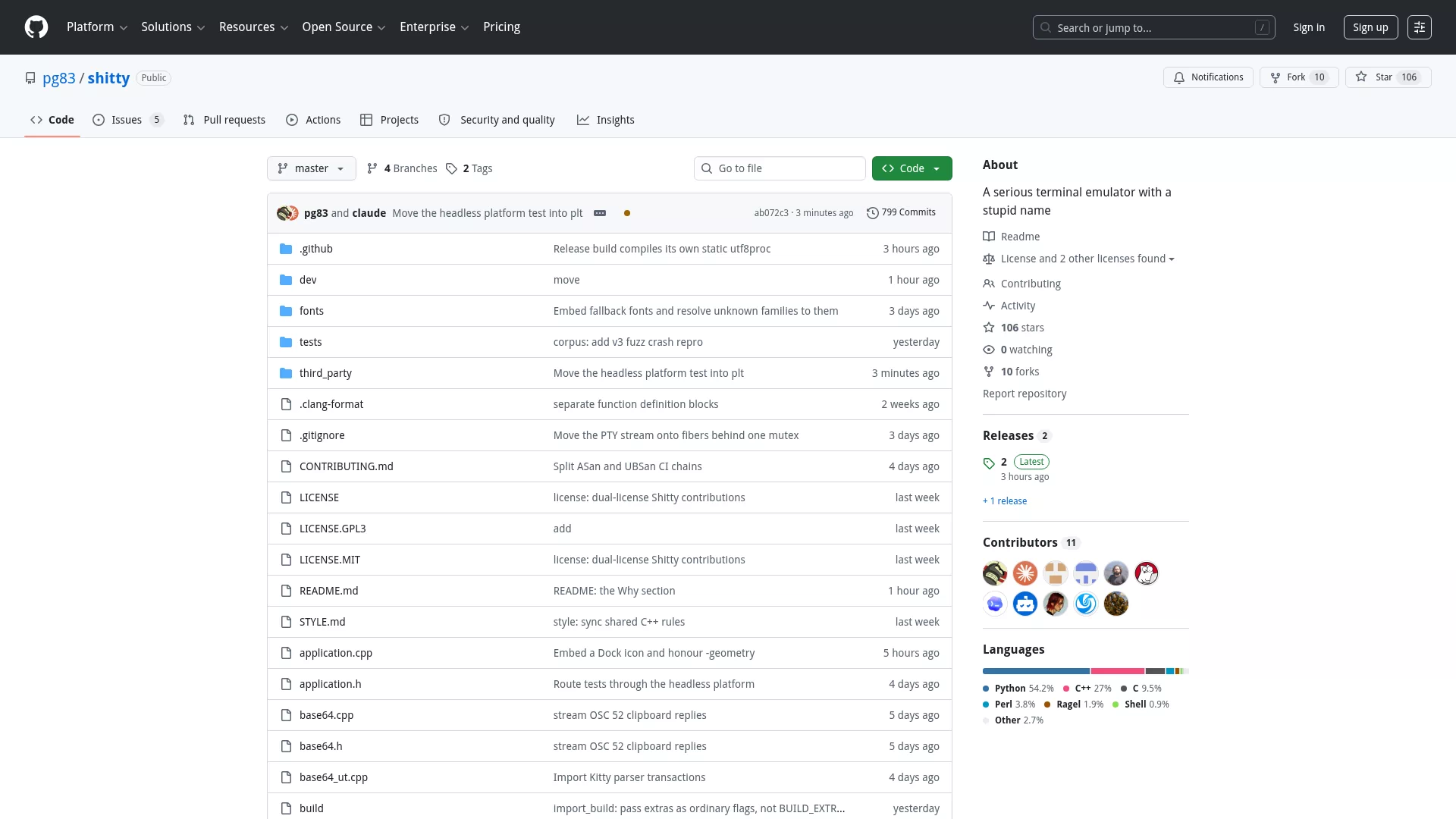
Shitty is a terminal emulator released in late July, 100+ stars on GitHub. The name is self-deprecating; the repo describes itself as "a serious terminal emulator with a stupid name".
It keeps terminal state on the CPU and renders with native compute backends, Vulkan on Linux and Metal on macOS. README benchmarks: ~118 MiB/s ASCII throughput, 1.2x alacritty; on random bytes the gap widens, ~51 MiB/s vs alacritty's ~31 MiB/s. The author says the comparison can be reproduced with dev/compare.py rather than being a one-off marketing chart.
For correctness, 5,000+ tests are harvested from a dozen suites — kitty, esctest, xterm's vttests, etc. — driven black-box through a real PTY. macOS and Linux, installable via brew, MIT/GPL-3.0 dual license.
Honestly, the 0.8s vs 1s difference is hard to feel in daily use, but terminal rendering hasn't seen much new blood in years, and Shitty re-opens that path with GPU backends. Worth watching.
Mu: the everyday internet as agent tools
Mu is a tools-for-agents ecosystem by the micro team (creators of the Go Micro framework). It wraps news, web search, mail, markets, weather, video and storage into tools agents can call over MCP or REST, paid per request, open source and self-hostable.
The one-liner on the site is clear: "The everyday internet as tools an agent can call." Plenty of people are building agent tools these days, but most cover only web search and scraping; bundling mail, markets and storage together is rarer. The micro team built a full microservices framework before this, so the server-side experience is real.
If you are assembling your own agent and do not want to integrate every data source by hand, Mu is a middle layer worth trying.
Draco: a single-binary, self-hostable Firecrawl alternative
Draco is a native-Rust web scraper positioned as a lighter alternative to Firecrawl / Browserbase. No Node, no headless-Chrome fleet — one self-hostable binary.
It uses browser-faithful TLS/JA4 fingerprints to reach pages that block ordinary clients. A standard HTML page returns clean Markdown plus metadata in ~300ms with no browser involved. Client-rendered SPAs go through a render-then-Markdown pipeline. Built-in MCP, free web search and a browserless JS console.
Firecrawl pricing is not cheap, and Draco rewrites the core URL-to-Markdown path in Rust while giving you full ownership. For RAG data pipelines feeding LLM apps, this fits right in.