What OpenAI's next-generation model Astra delivered
On August 1, OpenAI chief researcher Noam Brown posted on X that an internal version of Astra, the company's next major model family, had solved 10 open problems in mathematics, quantum complexity, and theoretical computer science. The tweet drew 8.4 million views and 21,000 reposts. OpenAI president Greg Brockman added the key figure: the total token cost of finding these solutions was roughly $2,000 at Sol API rates.
The same day, OpenAI published a detailed post titled "Ten advances in mathematics and theoretical computer science" and open-sourced Lean certificates for all the proofs on GitHub (the openai/ten-proofs repository).
The ten problems
Every problem in the announcement shares one trait: the main result had been open for at least a decade, in most cases much longer, with no real progress in between. The fields covered include high-dimensional geometry, coding theory, arithmetic circuit complexity, group theory, operator algebras, quantum complexity, lattice cryptography, and extremal combinatorics.
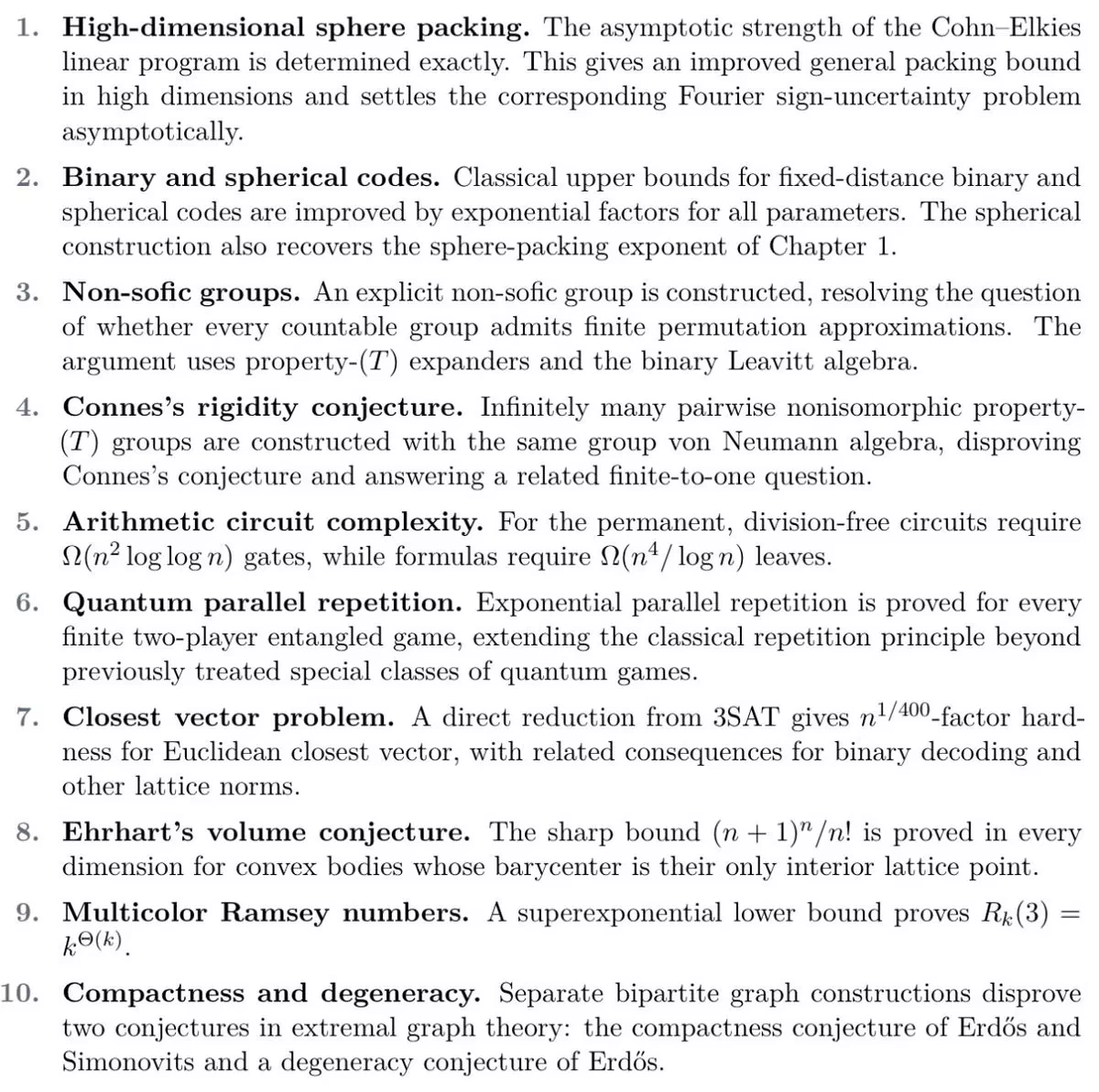
- High-dimensional sphere packing: new upper bounds on sphere-packing density down to the Cohn–Elkies threshold.
- Binary and spherical codes: exponentially improved bounds on the maximum size of binary codes at any prescribed minimum distance, with analogous results for high-dimensional spherical codes.
- Non-sofic groups: a construction establishing the existence of non-sofic groups, addressing a central open question in group theory.
- Connes' rigidity conjecture: a disproof of the long-standing conjecture that certain groups are uniquely determined by their von Neumann algebras.
- Arithmetic circuit complexity: new lower bounds for computing the permanent with arithmetic circuits and formulas, including a formula lower bound of order n⁴/log n.
- Quantum parallel repetition: an exponential parallel repetition theorem for general two-player quantum games, extending a foundational principle from classical complexity theory.
- Closest vector problem: polynomial-factor hardness of approximation for a foundational lattice problem tied to post-quantum cryptography.
- Ehrhart's volume conjecture: determining, in every dimension, the maximum possible volume of a convex body whose centroid is its only interior lattice point.
- Multicolor Ramsey numbers: a superexponential lower bound for multicolor triangle Ramsey numbers, resolving Erdős problem 183.
- Extremal number conjectures: results on the compactness and degeneracy conjectures in extremal graph theory, resolving Erdős problems 146 and 180.
Each result was prepared into a manuscript by humans working with the same model. Every argument was then formalized as a Lean certificate, alongside a model narration of its thinking process. OpenAI says it takes responsibility for the correctness of the proofs while making clear the mathematical arguments themselves were generated by its system.
Reactions: praise and skepticism
The announcement drew 451 points and 38 comments on Hacker News. Some see it as a turning point for mathematical research; others stayed cautious. Skeptics focused on two issues. First, the $2,000 figure only counts the tokens spent on the successful solutions, without disclosing how many problems were attempted or how many failures preceded them, so the real cost may be far higher. Second, OpenAI has not published its methodology, leaving the results hard to verify independently.
NYU psychology professor Gary Marcus published a long piece the same day titled "OpenAI's amazing — but vastly oversold — new model Astra." He concedes the model is genuinely strong at math, but argues that generalizing from "great at certain kinds of math" to "great at all cognition" is a fallacy of composition. Being good at math, he notes, does not mean the model won't hallucinate, can't reliably read PDFs, or will follow hard rules. In the same thread, Elon Musk took the news as evidence that the singularity is near, while Matt Shumer said GPT-next will make Fable look like a toy.
Why it matters
This is not the first time OpenAI has shown a model's mathematical ability. In May it published an AI-generated counterexample that disproved the Erdős unit-distance conjecture in discrete geometry. This time it's ten results at once, spanning fields from group theory to lattice cryptography. The verification approach matters too: every proof was formalized in Lean, turning "AI did mathematics" from a verbal claim into a machine-checkable certificate.
Astra remains an internal test version with no announced release schedule. But one line in the announcement is worth noting: OpenAI also launched ChatGPT for Academic Researchers, giving 100,000 scientists and mathematicians free access to its best ChatGPT models. An internal model delivering results on open problems on one side, free quota for academia on the other — the direction of OpenAI's science play is clear.