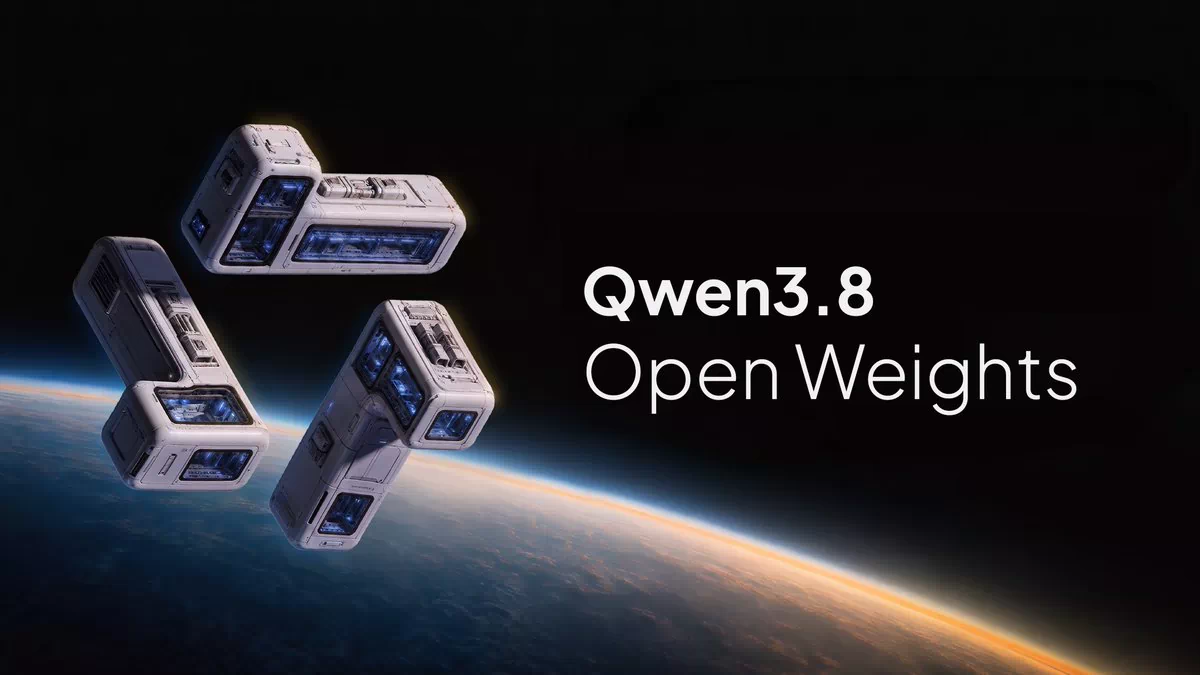
Qwen3.8-27B Open Weights Released: A 27B Model That Beats Claude Opus 4.6 Max on Key Coding Benchmarks
On August 14, Alibaba's Qwen team released the open weights of Qwen3.8-27B under Apache 2.0. It's the first open model of the Qwen3.8 family: a 27B dense multimodal model with native image and video understanding, 262K native context, extendable to 1M via YaRN. The announcement drew 890+ points on Hacker News within a day.
Specs: a 27B dense model that can see
Qwen3.8-27B is not a text-only model. It ships a vision encoder that handles STEM diagrams, documents, and hour-scale videos. The architecture follows Qwen3.5's hybrid design: 16 Gated DeltaNet (linear attention) blocks paired with one Gated Attention block, trained with multi-token prediction (MTP), keeping inference cheaper than a pure Transformer.
Thinking mode is on by default but can be disabled per request. reasoning_effort tunes depth, and preserve_thinking keeps reasoning context across turns. The whole setup targets long-horizon agent tasks.
Benchmarks: several results above Opus 4.6 Max
The official comparison table pits Qwen3.8-27B against Qwen3.6-27B, Qwen3.7-Plus, Google's Muse Glimmer-30B and Anthropic's Claude Opus 4.6 Max.
Key text results:
| Benchmark | Qwen3.8-27B | Qwen3.6-27B | Qwen3.7-Plus | Opus 4.6 Max |
|---|---|---|---|---|
| SWE-bench Pro | 61.7 | 53.5 | 57.6 | 53.4 |
| QwenSWEBench | 79.0 | 49.3 | 59.2 | 63.8 |
| DeepSWE 1.1 | 42.2 | 13.3 | 14.2 | — |
| LiveCodeBench v6 | 90.3 | 83.9 | 89.6 | 88.8 |
| Terminal Bench 2.1 | 73.0 | 63.4 | 64.0 | 78.2 |
| CoWorkBench | 70.7 | 61.0 | 65.1 | 68.2 |
| Agents' Last Exam (Pass@1) | 20.4 | 10.6 | 13.2 | — |
| GPQA Diamond | 89.2 | 87.8 | 90.3 | 91.3 |
It beats Opus 4.6 Max on SWE-bench Pro, QwenSWEBench, LiveCodeBench and CoWorkBench. The sharpest jump is DeepSWE 1.1: 42.2 versus 13.3 for the previous 27B generation. Community members report 42.2 on DeepSWE in a Claude Code setup, above Opus 4.7 Max with Claude Code at 40.
Multimodal and agent scores are strong too: OSWorld-Verified 84.3 (Opus 4.6 Max: 72.7), AndroidWorld 81.9 (62.0), MathVision 90.0, OmniDocBench 1.5 91.1. SWE-MM lands at 38.6, also above Opus 4.6 Max's 27.1.
Community reaction: "Opus at home"
The main appeal of this 27B model is that it runs on consumer hardware. Unsloth shipped GGUF quantizations the same day; one user measured roughly 48 tps with the q4km quant on an RTX 4090. HN commenters call it "Opus at home". Others suggest waiting a couple of weeks until llama.cpp fully catches up before judging.
How to get it
Weights are up on Hugging Face and ModelScope, in both FP8 and BF16. Officially compatible with Transformers, vLLM and SGLang. A hosted API on Qwen Cloud is coming soon, with 1M context and built-in tools by default.
Worth noting: open weights for Qwen3.8 Max (2.4T-A95B MoE, 95B active) landed a few days earlier, the largest open-weight release so far. The open version is text-only with forced thinking and 262K native context.
Meanwhile: DeepSeek V4 Pro goes GA, API moves to peak/off-peak pricing
On August 13, DeepSeek shipped the GA of V4-Pro (deepseek-v4-pro-0813), replacing the preview. The company claims major agent improvements, native OpenAI Responses API support, and one-click Codex setup. It also open-sourced DeepSeek Harness, an agent framework under the MIT license built around a plugin-everything design.
API pricing switches to peak/off-peak billing at 16:00 UTC on August 16. Off-peak rates are half of peak rates. Peak hours are 01:00-04:00 and 06:00-10:00 UTC; all other hours are off-peak.
| Model | Item | Old price | Off-peak | Peak |
|---|---|---|---|---|
| V4-Flash | Input | $0.14 | $0.22 (≈¥1.6) | $0.44 (≈¥3.2) |
| V4-Flash | Output | $0.28 | $0.66 (≈¥4.8) | $1.32 (≈¥9.6) |
| V4-Flash | Cache hit | $0.0028 | $0.007 (≈¥0.05) | $0.014 (≈¥0.10) |
| V4-Pro | Input | $0.435 | $0.66 (≈¥4.8) | $1.32 (≈¥9.6) |
| V4-Pro | Output | $0.87 | $1.98 (≈¥14.5) | $3.96 (≈¥28.9) |
| V4-Pro | Cache hit | $0.003625 | $0.022 (≈¥0.16) | $0.044 (≈¥0.32) |
Off-peak input prices are 1.5-1.6x the old rates and output 2.3-2.4x; at peak, input is 3x and output 4.6-4.7x. Cache hits take the biggest hit, up 12x for V4-Pro at peak. The HN thread was lively: some read it as a capacity signal, others note the models are open-weight so third-party providers still charge the old prices. Heavy API users can save half by moving workloads to off-peak hours.