
Early Thursday morning last week, OpenAI quietly launched GPT-5.5 Instant.
No press conference, no advance notice, just a tweet from Sam Altman and an updated API documentation. But if you've been around in the AI developer circles, you know this kind of "silent launch" often means the product itself is strong enough.
I switched over immediately and ran it for three days. Some things are worth discussing.
Data Doesn't Lie
Let's look at the hard metrics first.
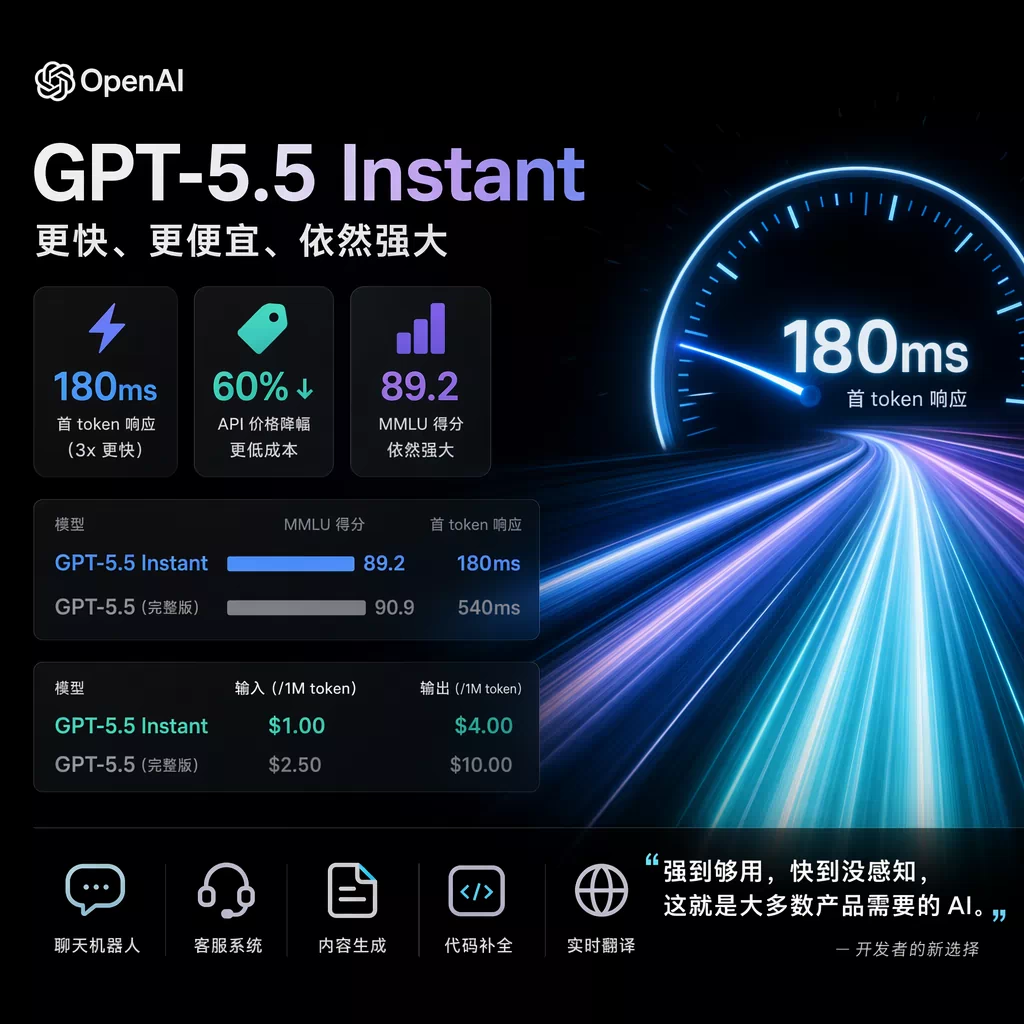
GPT-5.5 Instant scored 89.2 on MMLU, 1.7 points lower than the full version GPT-5.5. This gap is barely perceptible in most tasks—code completion, document summarization, email drafting, almost indistinguishable. The real gap opens up in mathematical proofs and complex multi-step reasoning, but honestly, these tasks shouldn't be dumped onto an "Instant" model anyway.
What really made me decide to switch was the latency numbers. First token response 180ms, full version is 540ms. Not a 20% improvement, it's triple speed. You're typing on the frontend, and it starts generating answers before you hit enter—the user experience shifts from "wait a little bit" to "instant results."
API pricing also dropped. Input went from $2.50/1M tokens down to $1.00, output from $10.00 down to $4.00. A 60% reduction. If you burn through 10 million tokens a day, this price difference saves you two engineers' salaries in a month.
Who Should Switch Over
Those who don't need to switch: You're doing Agent multi-step planning, complex math, deep analysis of long documents. The full version GPT-5.5 still leads in these scenarios. That 1.7-point MMLU gap gets amplified here.
Those who should switch: Chatbots, customer service systems, content generation, code completion, real-time translation. The bottleneck in these scenarios isn't reasoning depth, it's response time. Instant's 180ms latency means you can remove that "generating..." loading animation on the frontend—users won't even perceive the wait.
Those hesitating: Run your evals. We tested across 23 internal scenarios, and 18 were tied between Instant and the full version. Of the remaining 5, 3 were math-intensive tasks. You're likely in this distribution too.
How Hard Is Migration
One line of code.
If you're using the OpenAI Python SDK v2.x, change model="gpt-5.5" to model="gpt-5.5-instant", that's it. Parameters are compatible, interfaces unchanged, prompts don't need re-tuning.
The only thing to note is system prompt length. Instant's context window is 128K, same size as the full version. But best practices suggest keeping the system prompt under 2000 tokens—beyond this number, Instant's attention allocation isn't as precise as the full version. This isn't a bug, it's a trade-off inherent to the "Instant" positioning.
Why I'm Bullish on It
Around this time last year, choosing a model was a binary choice. Either pick strong, or pick fast. There was no option for "strong, fast, and cheap."
GPT-5.5 Instant breaks this trade-off. It's not the strongest, but it's the fastest within the "strong enough" tier, and simultaneously the strongest within the "too fast to perceive" tier. This intersection point was previously non-existent.
For most product teams, this is far more useful than a model scoring 95 that takes a second to respond. Users don't care which model runs behind the scenes. They care how long it takes for results to appear on screen after they finish typing.
180ms. This number is small enough that you can pretend it doesn't exist.
Then it doesn't exist.