Technical Architecture and Core Breakthroughs
GPT-5.5 is OpenAI's first fully retrained foundation model since GPT-4.5, representing not just a minor version iteration but a fundamental architectural reconstruction. The model was co-designed with NVIDIA's GB200/GB300 NVL72 systems, achieving deep hardware-software synergy from training through deployment.
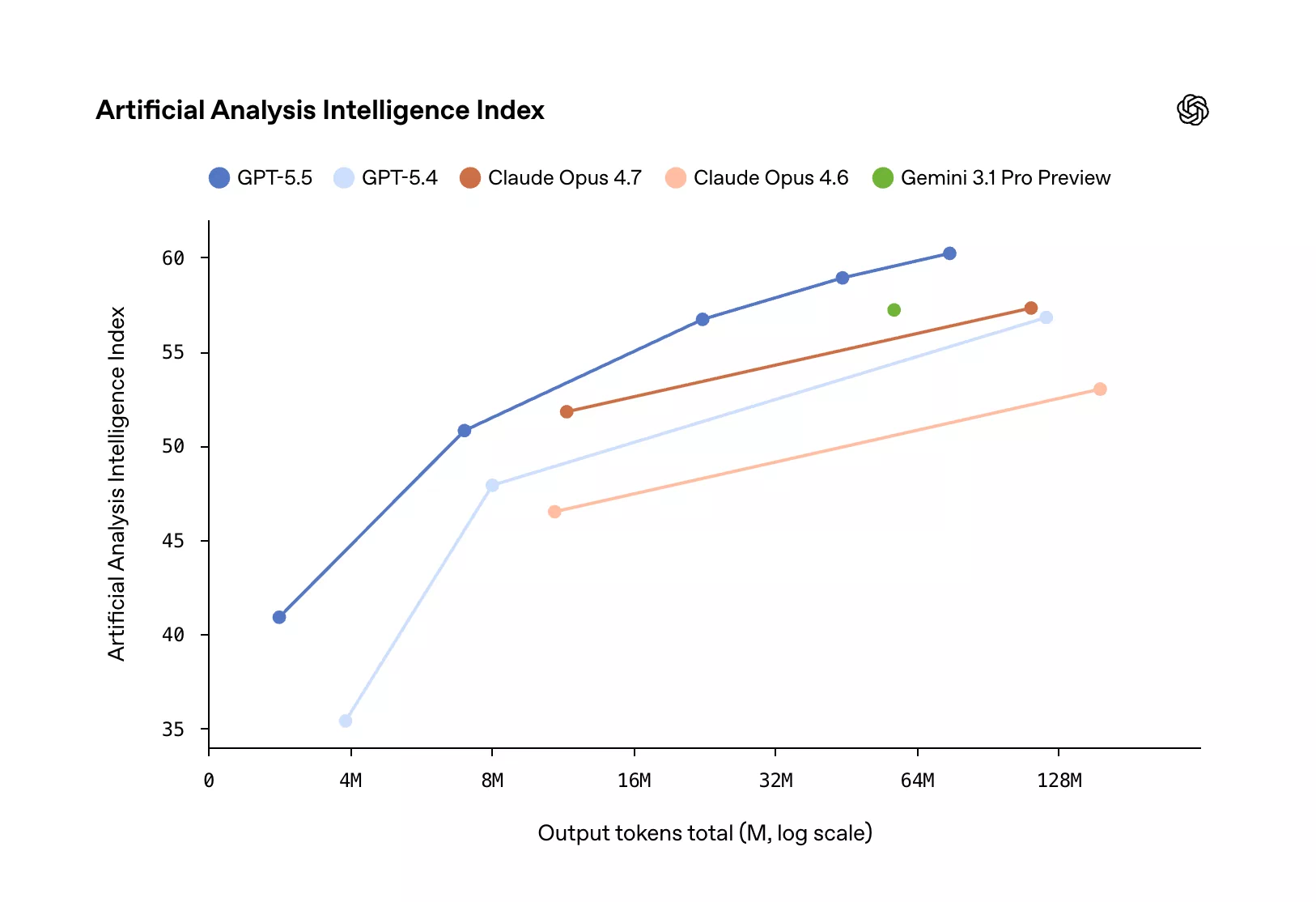
The most striking breakthrough lies in balancing efficiency and intelligence. Despite being larger and more capable, GPT-5.5 maintains the same per-token latency as GPT-5.4 in actual services. More critically, when completing identical Codex tasks, GPT-5.5 consumes significantly fewer tokens. On the NVIDIA GB200 NVL72 system, inference cost per million tokens has dropped to 1/35 of the previous generation.
Comprehensive Performance Superiority
GPT-5.5 surpasses GPT-5.4 across multiple key benchmarks, especially excelling in long-horizon tasks and agent capabilities:
| Benchmark | GPT-5.5 | GPT-5.4 | Improvement | Test Content |
|---|---|---|---|---|
| Terminal-Bench 2.0 | 82.7% | 75.1% | +7.6% | Complex command-line workflows |
| Expert-SWE | 73.1% | 68.5% | +4.6% | Long-cycle engineering tasks |
| SWE-Bench Pro | 58.6% | 57.7% | +0.9% | Real-world GitHub issue fixes |
| GDPval | 84.9% | 83.0% | +1.9% | Knowledge work across 44 professions |
| OSWorld-Verified | 78.7% | 75.0% | +3.7% | Real computer operations |
| Tau2-bench Telecom | 98.0% | 92.8% | +5.2% | Complex customer service workflows |
| MRCR v2 512K-1M | 74.0% | 36.6% | +37.4% | Long-text multi-point retrieval |
| Graphwalks BFS 1M | 45.4% | 9.4% | +36.0% | Long-context structure tracking |
| FrontierMath Tier 4 | 35.4% | 27.1% | +8.3% | Advanced mathematical tasks |
| BixBench | 80.5% | 74.0% | +6.5% | Bioinformatics analysis |
| GeneBench | 25.0% | 19.0% | +6.0% | Gene data analysis |
Source: OpenAI official release and third-party evaluations
Qualitative Leap in Agent Capabilities
GPT-5.5's core design philosophy has shifted from a "collection of capabilities" to a "work system." Users can directly throw messy, multi-step complex tasks at the model, allowing it to autonomously plan paths, call tools, verify results, resolve ambiguities, and continuously drive progress until completion.
In programming, this change is especially evident. Early testers report that GPT-5.5 is significantly better at understanding the overall structure of large codebases, proactively anticipating potential issues, and considering testing and review needs without extra prompting. One NVIDIA engineer remarked after early testing: "Losing access to GPT-5.5 feels like having a limb amputated."
Substantial Breakthrough in Long-Context Capabilities
Although GPT-5.4 claimed support for a 1 million token context, it performed poorly on ultra-long text retrieval (only 36.6% in the 512K-1M range). GPT-5.5 raises this figure to 74.0%, an improvement of 37.4 percentage points, making the 1M context window truly practical.
This breakthrough is revolutionary for scenarios requiring processing large codebases or lengthy document analysis. The Codex environment supports a 400K context window, while the API version supports 1M context (requires explicit configuration), with a maximum output of 131,072 tokens.
New Heights in Scientific Research and Knowledge Work
In scientific research, GPT-5.5 demonstrates impressive capabilities. An internal model version successfully proved a long-standing conjecture about Ramsey numbers and completed formal verification in the proof assistant Lean. Ramsey numbers are core objects of study in combinatorial mathematics, and related results are typically extremely technically demanding and rare.
In the bioinformatics benchmark BixBench, GPT-5.5 achieved 80.5%, ranking first among all published model scores. Derya Unutmaz, Professor of Immunology at Jackson Laboratory for Genomic Medicine, used GPT-5.5 Pro to analyze a gene expression dataset containing 62 samples and nearly 28,000 genes, generating a detailed research report. He stated that this work would have originally required months from a team.
Pricing Strategy and Market Positioning
GPT-5.5 API pricing is $5 per million input tokens and $30 per million output tokens, double that of GPT-5.4 ($2.50 input, $15 output). GPT-5.5 Pro API pricing is higher at $30 input and $180 output per million tokens.
However, OpenAI emphasizes that because GPT-5.5 requires significantly fewer tokens to complete the same tasks, overall usage costs may not rise substantially. Batch processing and elastic pricing enjoy a 50% discount, while priority processing is 2.5 times the standard price.
Availability and Deployment
Currently, GPT-5.5 is available to ChatGPT Plus, Pro, Business, and Enterprise users, appearing in ChatGPT as "GPT-5.5 Thinking." Codex supports up to a 400K context window. The API version will be available soon, with standard pricing at $5 per million input tokens and $30 per million output tokens.
Safety and Governance
GPT-5.5 underwent OpenAI's most rigorous safety evaluation process, including preparatory framework assessments, domain-specific tests, new targeted assessments for advanced biology and cybersecurity capabilities, and robust testing with external experts. OpenAI classifies GPT-5.5's biological/chemical and cybersecurity capabilities as "high" level. While not reaching "critical" level, its cybersecurity capabilities have significantly improved compared to GPT-5.4.
Industry Impact and Competitive Landscape
GPT-5.5's launch comes as Anthropic's valuation in the private secondary market exceeds $1 trillion, while OpenAI's most recent funding round at the end of March this year valued it at only $852 billion. This release is seen as OpenAI's direct response to competitive pressure.
On the comprehensive intelligence index rankings from third-party evaluator Artificial Analysis, OpenAI secured first and second places with the GPT-5.5 series, taking four of the top six spots. However, on SWE-Bench Pro (evaluating real GitHub issue resolution capabilities), Claude Opus 4.7 still leads with 64.3% compared to GPT-5.5's 58.6%.
Future Outlook
GPT-5.5 represents AI's shift from an auxiliary tool to a collaborative partner. It is no longer just an answer engine but an agent capable of understanding complex goals, autonomously planning execution paths, and continuously driving tasks to completion. With the model's deep application in code writing, scientific research, knowledge work, and other fields, GPT-5.5 is poised to redefine the working model of human-machine collaboration.
OpenAI President Greg Brockman emphasized that GPT-5.5's core breakthrough is its ability to accomplish more with less guidance, with the biggest highlight being its enhanced autonomy in handling ambiguous problems. This characteristic makes GPT-5.5 not just a more powerful model, but a new working paradigm.
With the full deployment of GPT-5.5, the AI industry has officially entered the "era of agents." Models are no longer merely tools that execute instructions but partners capable of understanding intent, planning paths, and acting autonomously. This transformation will have profound impacts on software development, scientific research, enterprise operations, and various other fields.
Affordable Model Usage
Still troubled by model selection and integration debugging? LinkThinkAI offers you a one-stop solution.
We now fully support cutting-edge models such as DeepSeek-V4, GPT-5.5, and GPT-Image-2. Through our API, which is uniformly aligned with the OpenAI style, you only need to change the Base URL to quickly switch and go live, greatly reducing integration and migration costs.
Register now and get an exclusive 25% discount when calling GPT series models through our platform, helping you experience top-tier model capabilities at a lower cost.
Our platform integrates multiple suppliers and multimodal capabilities, offering:
- Flexible Routing: Supports channel, group, and fallback strategy configuration to ensure high service availability.
- Clear Costing: Model multipliers, usage statistics, and grouping strategies make budgeting and billing transparent.
- Simple Integration: From account creation to the first successful call, the steps are clear and straightforward.
Say goodbye to tedious individual integrations. Manage all models with one document and one API key. Visit https://linkthinkai.com now to start your efficient, stable, and cost-effective model calling journey.