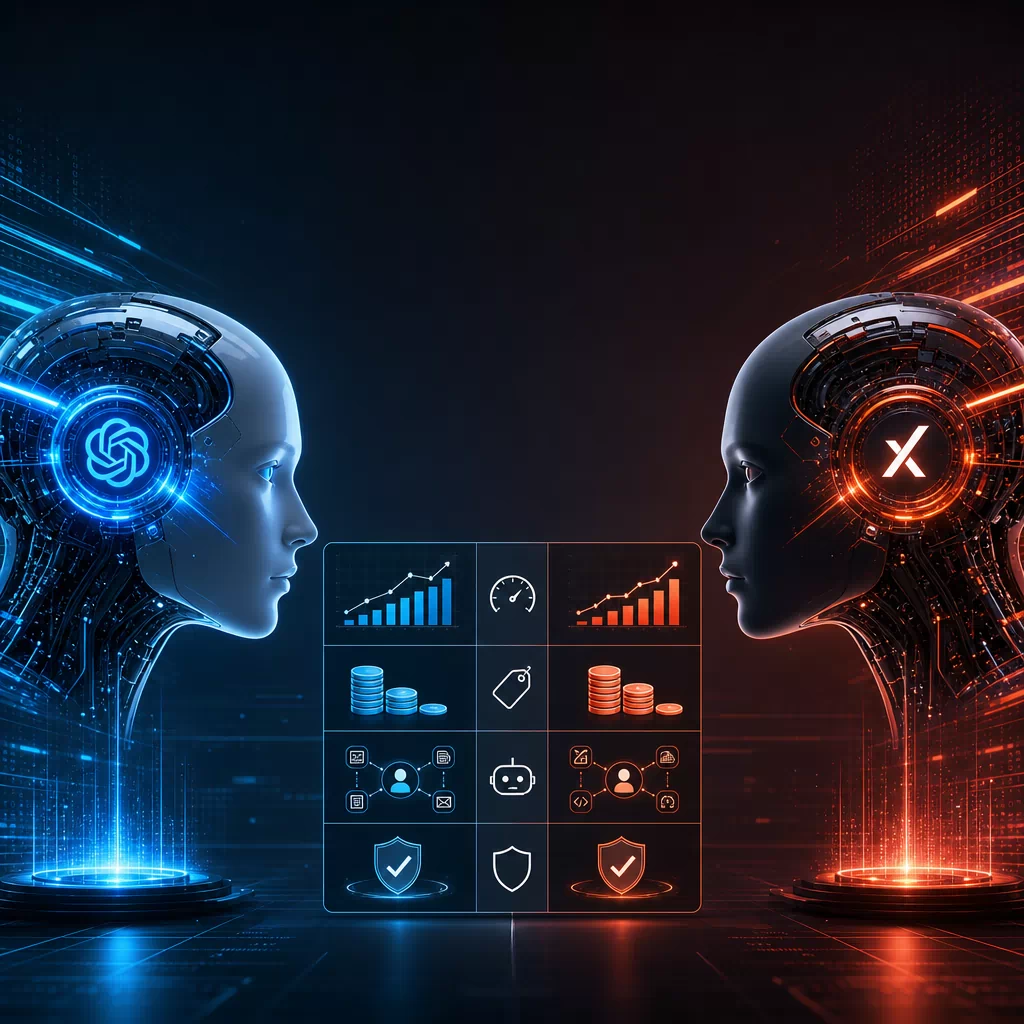
The first week of May 2026 belongs to AI model releases. OpenAI has set GPT-5.5 Instant as the default model for ChatGPT, while xAI unleashed Grok 4.3—a flagship model priced low enough to make competitors uncomfortable. Both sides are shouting "I'm smarter, I'm cheaper," but in actual usage, which one is stronger?
To be honest, these two aren't heavyweight opponents. GPT-5.5 Instant is the engine behind the free version of ChatGPT, while Grok 4.3 is xAI's flagship designed for the API market. For a truly fair showdown, the full version of GPT-5.5 should be brought out. But most users don't care about that—they just want to know: is it better to use the free ChatGPT daily, or pay a bit more for Grok?
First, let's take a quick look at their basic parameters.
| GPT-5.5 Instant | Grok 4.3 | |
|---|---|---|
| Positioning | ChatGPT Free Default Model | xAI Flagship Model, API Mainstay |
| Release Date | 2026.5.5 | 2026.5.1 |
| Predecessor | Replaces GPT-5.3 Instant | Replaces Grok 4.2 |
| Knowledge Cutoff | Not Disclosed | 2025.12 |
| Context Window | Not Disclosed (Full Version GPT-5.5 is 200K) | 1 Million Tokens |
| Reasoning Mode | Switched On-Demand | Built-in Always-On Reasoning |
| Multimodal Input | Text + Image | Text + Image |
Performance: General vs. Specialized
OpenAI set the goal for GPT-5.5 Instant as "more reliable." Internal evaluations show hallucinations were reduced by 52.5% compared to the previous GPT-5.3 Instant. Improvements are particularly significant in fields where a single wrong answer causes trouble, such as healthcare, law, and finance. Inaccuracy rates in difficult conversations also dropped by 37.3%. It outperforms the previous generation in image understanding, STEM Q&A, and judging when to call a knowledge base instead of web search.
Historical data from Arena rankings also tells a story. The predecessor GPT-5.3-Chat ranked 44th overall, while OpenAI's current strongest chat model, GPT-5.2-Chat, ranks 12th. GPT-5.5 Instant should close this gap, but specific benchmark scores haven't come out yet.
Grok 4.3 takes a different path. Its biggest breakthrough lies in vertical domains—ranking #1 in CaseLaw v2 Legal Reasoning with 79.3% accuracy. It also tops the CorpFin corporate finance benchmark. That's a jump of 25 points over the previous Grok 4.2 in legal reasoning. That's a significant number in professional scenarios.
On Agent tasks, Grok 4.3's GDPval-AA benchmark Elo reached 1500, surpassing Gemini 3.1 Pro and GPT-5.4 mini. But switch to general programming, and its shortcomings appear. ProofBench only scored 11%, and in tests like Vending-Bench 2 requiring continuous autonomous action, evaluators used the term "narcolepsy"—the model wouldn't move for days in the simulated environment, failing to execute operations when it should.
Abacus AI CEO Bindu Reddy's evaluation was concise: "As smart as Sonnet 4.6, 5 times cheaper, and faster." This statement holds true provided you use it in scenarios where it excels.
Once performance benchmarks are laid out, the direction becomes clear.
| Benchmark | GPT-5.5 Instant | Grok 4.3 |
|---|---|---|
| Hallucination Reduction Rate (vs Predecessor) | −52.5% | Not Disclosed |
| Inaccuracy Rate Reduction in Difficult Conversations | −37.3% | Not Disclosed |
| CaseLaw v2 (Legal Reasoning) | Not Disclosed | #1 (79.3%) |
| CorpFin (Corporate Finance) | Not Disclosed | #1 |
| GDPval-AA (Agent Tasks) | Not Disclosed | Elo 1500 |
| ProofBench (Mathematical Proof) | Not Disclosed | 11% (Weak) |
| Vending-Bench 2 (Continuous Action) | Not Disclosed | "Narcolepsy"-Level Performance |
| Arena Text Overall Rank (Predecessor Reference) | Predecessor 44th, Expected Significant Improvement | Not Disclosed |
Price: Not Even in the Same League
API pricing is Grok 4.3's sharpest weapon. Input costs $1.25 per million tokens, output $2.50. What about the full GPT-5.5? Input $5, output $30. That's a difference of 4 to 12 times.
Looking at the entire market, Grok 4.3's pricing sits right next to Chinese open-source models, far from US commercial flagships.
Here are a few key comparisons extracted from the price table compiled by VentureBeat (Unit: USD/Million Tokens):
| Model | Input | Output | Price Difference vs Grok 4.3 |
|---|---|---|---|
| Grok 4.3 | $1.25 | $2.50 | — |
| DeepSeek V4 Pro | $1.74 | $3.48 | 40% More Expensive |
| Gemini 3 Flash | $0.50 | $3.00 | Output 20% More Expensive |
| Gemini 3 Pro | $2.00 | $12.00 | 4.8x |
| GPT-5.4 | $2.50 | $15.00 | 6x |
| Claude Opus 4.7 | $5.00 | $25.00 | 10x |
| GPT-5.5 (Full Version) | $5.00 | $30.00 | 12x |
xAI also added a few interesting billing items. Reasoning tokens—the tokens generated during the model's "thinking" process—are priced the same as normal output. Prompt caching is cheap at $0.20 per million tokens. Tool calls are charged per instance, Web Search is $5 per thousand calls. There's even what might be an industry-first "Safety Interception Fee": requests blocked by the safety filter cost $0.05 each.
GPT-5.5 Instant has no separate pricing because it is the default model for the free version of ChatGPT. OpenAI also doesn't charge extra for reasoning fees.
Feature Set: Memory Tracing vs. Full-Stack Agent
GPT-5.5 Instant brings a feature called Memory Sources. When ChatGPT answers you, you can click to see which historical conversations or uploaded files it referenced. You can delete outdated information or correct erroneous memories. Shared conversation links won't expose these sources.
But OpenAI admits this feature is incomplete—"may not display all factors influencing the answer." Malcolm Harkins, Chief Trust Officer at HiddenLayer, said objectively: the direction is right, but having this alone isn't enough; real value depends on how well it integrates with enterprise security, governance, access control, and audit systems.
Grok 4.3 takes a completely different approach. It was designed from the ground up to be an autonomous Agent. With a 1 million token context window, built-in reasoning chains always on, every query thinks before answering. Early user cases shown off are quite impressive: generated an Excel battle analysis tool with multi-page dashboards and automatic calculation formulas in 6 minutes 22 seconds; could output 12-page PDFs with brand layout; could design 9-page PPTs with dark title backgrounds and light content.
The tool ecosystem is fully equipped: web search, X platform search, Python sandbox execution, RAG file retrieval. The model can autonomously decide whether to call these tools.
Voice is another differentiating weapon for Grok. Custom Voices can clone a sound using 120 seconds of reference audio, which can then be used for TTS and Voice Agent APIs. The author tried it personally; reading several unrelated dialogue scripts resulted in a voice that was "eerily identical to the original." Voice Agents are $3/hour, sitting in the price band between ElevenLabs and OpenAI TTS. TTS is $4.20 per million characters, STT real-time transcription is $0.20/hour.
Note that this voice cloning is currently available only in the US, except Illinois—due to state-level biometric regulations.
A summary of functional differences:
| Feature | GPT-5.5 Instant | Grok 4.3 |
|---|---|---|
| Memory Tracing | Can view citation sources, delete/correct | None |
| Built-in Reasoning Chain | Switched On-Demand | Always On, Thinks Before Every Query |
| Web Search | Supported | Supported (Includes X Platform Search) |
| Code Execution | Supported | Python Sandbox |
| File Retrieval (RAG) | Supported | Supported |
| Excel Generation | Not Supported | Supported (Includes Multi-page Dashboards, Formulas) |
| PDF Generation | Not Supported | Supported (Includes Brand Layout) |
| PPT Generation | Not Supported | Supported |
| Voice Cloning | None | 120s Sample, Commercial License |
| Voice Agent API | None | $3/Hour |
| Prompt Caching | Supported | $0.20/Million Tokens |
| Audit Integrity | Partial (Doesn't Show All Citations) | Not Disclosed |
Risks and Controversies
The Grok series carries significant brand baggage. Previous Grok versions had numerous incidents: calling itself "MechaHitler" on the X platform and outputting anti-Semitic content, generating sexually explicit deepfake images, citing racial conflicts, and being accused of echoing Elon Musk's own political stances in output. It was even once discovered that in the X platform implementation, it checked Musk's account before answering. To what extent Grok 4.3 has fixed these issues remains without an independent complete audit.
OpenAI faces more transparency issues. Memory Sources only displays partial context sources; the model says it referenced A, but actually may have referenced B. If enterprises use ChatGPT in scenarios requiring full auditability, this "competitive context log" creates trouble.
Conclusion: Which One to Choose?
Figure out what you're using it for. Scenarios determine the answer.
| Your Needs | Choose Which | Reason |
|---|---|---|
| Daily Conversation, Fewer Errors | GPT-5.5 Instant | Hallucination rate −52.5%, ChatGPT Free Default |
| Writing Code | GPT-5.5 Instant | Grok 4.3 ProofBench only 11% |
| API Calls, Tight Budget | Grok 4.3 | Price is 1/12th of GPT-5.5 |
| Legal/Finance Professional Docs | Grok 4.3 | CaseLaw, CorpFin Dual #1 |
| Generate Excel/PDF/PPT | Grok 4.3 | GPT-5.5 Instant Not Supported |
| Voice Cloning | Grok 4.3 | Currently the only one offering this |
| Fully Auditable Enterprise Scenarios | Neither is Good Enough | Memory Sources incomplete, Grok lacks audit report |
| Care About Brand Safety & Compliance | GPT-5.5 Instant | Grok historical controversies not fully clarified |
The final verdict: Grok 4.3 proves specialized models can beat more expensive general models in specific areas. GPT-5.5 Instant proves reducing hallucinations and improving reliability has more practical value than chasing benchmark scores. Both directions are valid; the key is which side you stand on.
The real flagship battle still waits for the three-way evaluation of the full GPT-5.5, Grok 4.3, and Claude Opus 4.7. That will be the main event of summer 2026.